Skip to content
  • About Us
    • Who We Serve
  • Solutions
    • HIPAA for Covered Entities
    • OSHA for Healthcare
    • HIPAA for Business Associates
    • SRA for Covered Entities
    • Abyde Incident Response Program
    • Abyde Reseller Program
  • Resources
  • News
  • Events
  • Partners
  • Contact Us
  • Login
    • HIPAA for Covered Entities
    • OSHA for Healthcare
    • HIPAA for Business Associates
    • SRA for Covered Entities
SIGN UP
BOOK A DEMO

Compliance Catastrophes: Improper Access of PHI by Staff

April 24, 2024

It’s hump day! As we get through this middle bump of the week, we’re still rolling our series, Compliance Catastrophes; real-ish world examples of nightmare scenarios! 

Today, we’re looking at you, healthcare workers and Business Associates! We know you do amazing work when taking care of patients, but keeping data secure is a part of building an awesome practice or business environment. 

When given the keys to keep Protected Health Information (PHI) safe, it doesn’t mean to open the treasure chest of data! When working in this field, you’re around a lot of sensitive information, and it’s vital to uphold your commitment to patients by keeping it confidential! 

We know it’s not all healthcare workers or their associates, but more people break this rule than you’d expect. 

We’re getting scientific! There was a recent study that highlighted over 400 employees inappropriately accessing PHI at a hospital, and many only stopped accessing unauthorized PHI due to being warned they were caught by email.  

It shouldn’t take being caught to change bad behavior! You know the drill – improperly accessing PHI is a breach of trust. 

But just to be safe, let’s see an example of what you should not do. Now, joining us today, you guessed it, is our unlucky friend, Catastrophe Cathy. 

PHI Peeking

Cathy was at the front desk when a familiar face showed up for an appointment. An old friend from high school that she hasn’t seen in years! 

They chat for a little bit, and Cathy can’t help but wonder what brought this friend in. 

When she’s closing up, she can’t ignore the voice in the back of her head to go look. She falls for the temptation and searches for her friend’s medical information, curious about what brought her old friend into the practice. 

As she’s reading about her old friend, another employee notices what she’s doing. Cathy is embarrassed and ashamed, as well as she should be! She was breaching her old friend’s PHI. That information is strictly confidential, no matter how close they used to be. 

Real Life: Real Fines

You might think that a situation like this could never happen to you, but it happens often and there are severe consequences. 

Last year, the OCR fined Yakima Valley Memorial Hospital in Washington State due to some snooping security guards. Curiosity didn’t kill the cat, but did leave it with a hefty fine! Over 400 patients’ records were looked at and the hospital was charged with a pretty expensive bill: $240,000! 

To avoid snooping breaches, make sure all staff are properly trained on their roles and responsibilities. Access controls need to be monitored often, ensuring staff only have access to what pertains to their role. Additionally, make sure logs are reviewed, keeping your eyes open for any suspicious activity.  

We all deserve our health information to be secure, and healthcare workers and business associates are at the front lines of keeping it confidential. To learn more about common compliance catastrophes, email us at info@abyde.com and stay tuned for the next in our series on our social media! 
RECENT POSTS

  • Ambry Phishing Settlement
    $700K HIPAA Settlement: What the Ambry Genetics Phishing Breach Teaches Every Practice
  • Azul Vision Right of Access
    Right of Access Enforcement Hits Eye Care: Inside the Azul Vision Settlement
  • OSF Healthcare HIPAA Settlement
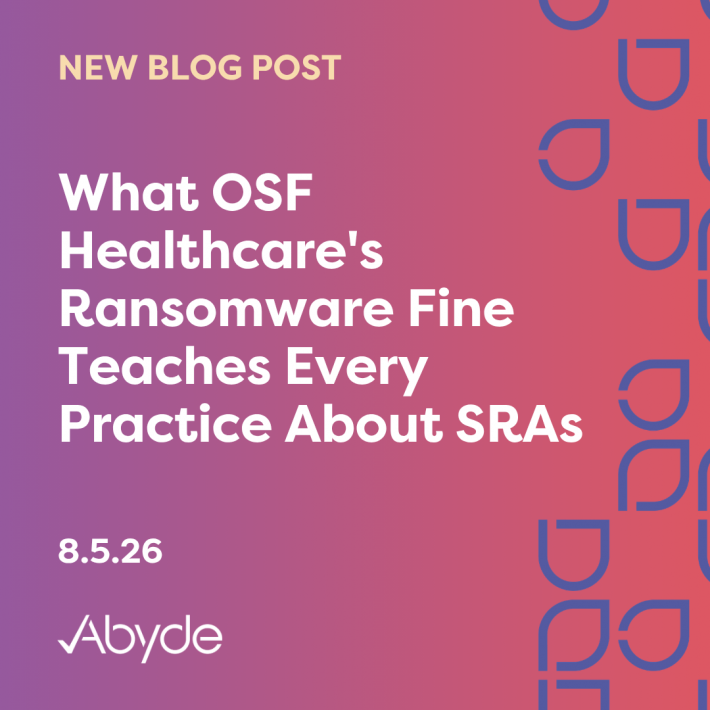
    What OSF Healthcare's Ransomware Fine Teaches Every Practice About SRAs
PrevPreviousCompliance Catastrophes: Stolen Devices
NextThe Brief History of HIPAA: How We Got Here and Why it MattersNext

Related posts

Ambry Phishing Settlement
Abyde News, Fines, HIPAA

$700K HIPAA Settlement: What the Ambry Genetics Phishing Breach Teaches Every Practice

September 21, 2026 Penelope Schweitzer No comments yet

September 21, 2026   The HHS Office for Civil Rights (OCR) has announced its biggest HIPAA settlement of the year, reaching nearly a million dollars.  Ambry, a genetic testing and clinical genomics provider based in Aliso Viejo, California is at the center of this enforcement. A settlement was reached over a 2020 phishing attack that exposed the Protected Health Information (PHI) of more than 225,000 individuals. This settlement is a clear reminder that even large organizations trip up on HIPAA requirements.    What happened In January 2020, an employee email account at Ambry was compromised through a phishing attack.  The breach potentially exposed a wide range of PHI, including names, addresses, dates of birth, Social Security Numbers, financial details, and more. Ambry reported the breach to OCR in March 2020, which kicked off the investigation.    Where OCR found gaps OCR’s investigation identified several HIPAA Security Rule gaps, including: No accurate, thorough risk analysis of risks and vulnerabilities to ePHI No process for cutting off access to ePHI when an employee left or no longer needed access No unique user IDs for tracking who was accessing ePHI systems These are baseline HIPAA requirements that every Covered Entity and Business Associate is expected to have in place.   The settlement terms Ambry paid $700,000 and agreed to a two-year corrective action plan, under which it must: Complete a thorough risk analysis of ePHI confidentiality, integrity, and availability Build and execute a risk management plan addressing what that analysis turns up Review and update Security Rule policies and procedures as needed Implement unique user identification across all ePHI systems Train the whole workforce on those updated policies The takeaway for practices When 90% of healthcare hacks start with a successful phishing attempt, it’s key your team is aware of the role they play to keep data safe. Every practice should ask; Do we know exactly where our ePHI lives and how it moves through our systems? Do we have a current, documented risk analysis? Would we catch it fast if a former employee’s access wasn’t revoked? Looking for the first step of addressing these gaps? Meet with one of our compliance experts to see where you currently stand. 

Azul Vision Right of Access
Abyde News, Fines, HIPAA

Right of Access Enforcement Hits Eye Care: Inside the Azul Vision Settlement

September 1, 2026 Penelope Schweitzer No comments yet

September 1, 2026   The Office for Civil Rights (OCR) announced its 55th settlement under the HIPAA Right of Access Initiative, and this one is a good reminder that “we’ll get to it” is an easy shortcut to a massive financial penalty.   What happened Azul Vision, Inc., a California optometry enterprise healthcare provider, took nearly two years to provide a patient her healthcare records failed to give a patient timely access to her health records. She requested her records in January 2023. She didn’t actually receive them until January 2025, or two years later, and only after OCR opened an investigation following her complaint in April 2023.   The importance of Right of Access The HIPAA Privacy Rule’s Right of Access is straightforward: patients are entitled to their healthcare records within 30 days of a request, with one possible 30-day extension if needed.    The cost Azul Vision agreed to a two-year, OCR-monitored corrective action plan and paid $50,000. The corrective action plan requires the practice to: Review and revise its written policies and procedures for Privacy Rule compliance.  Regularly report to HHS a log of every PHI access request it receives, including when it came in and when it was resolved, Train all workforce members on right of access requirements and the practice’s own procedures.   Practical takeaways Have a documented, assigned process for access requests: not an informal “someone will handle it” arrangement. Track every request against the 30-day (or extended 60-day) clock: If nothing is timestamping requests, nothing is catching the ones that slip. Train staff specifically on right of access: this is a distinct Privacy Rule obligation from general HIPAA awareness, and it’s clearly one OCR is actively enforcing.   The bottom line A single records request that went unanswered turned into a $50,000 penalty, two years of federal monitoring, and a detrimental hit to the organization’s reputation. That’s a steep price for what really comes down to a missing process. If your team can’t answer “what happens the moment a patient asks for their records?” right now, that’s the gap to close before your practice ends up as OCR’s next enforcement case. Want a streamlined way to close your compliance gaps? Meet with an Abyde expert today!

OSF Healthcare HIPAA Settlement
Abyde News, Fines, HIPAA

What OSF Healthcare’s Ransomware Fine Teaches Every Practice About SRAs

August 5, 2026 Penelope Schweitzer No comments yet

August 5, 2026 The latest HIPAA fine is another clear reminder that ransomware attacks are, unfortunately, here to stay in the healthcare industry. A settlement involving the OSF Healthcare System was recently announced by the Office for Civil Rights (OCR). As an enterprise healthcare provider in the midwest, the organization serves 174 locations, including 16 hospitals – a prime target for a ransomware attack.    So, what happened?  In April 2021, OSF discovered that they joined the unlucky club of ransomware victims when a malicious actor deployed Nephilim, a ransomware strain made to target larger organizations. Once the ransomware infected OSF systems, the hacker demanded payment or patient Protected Health Information (PHI) would be leaked online. In this attack, sensitive information like financial account information, driver’s license numbers, medical record numbers, and more, were all exposed. Over 53,000 patient records were exposed in this attack.  When ransomware attacks in healthcare have soared 278% in recent years, it’s more of a when then an if your organization doesn’t have the right safeguards in place.  While the breach was discovered in April, OSF healthcare reported the breach to the OCR in October. The OCR took it from there, digging into what precautions (or lack thereof) let this happen.  What did the OCR discover? If you’ve read any of our other fine breakdowns, you already know where this is going: another missing Security Risk Analysis (SRA).  The SRA is a required document every HIPAA-regulated entity (ie: every practice and their Business Associates that handle patient information) needs to complete. The SRA is a thorough review of the physical, technical, and administrative safeguards in place to prevent PHI ending up in the wrong hands. While the OCR didn’t specify exactly how the ransomware got into OSF’s system, a technical safeguard vulnerability was very likely the entry point. A proactive SRA could have flagged that gap before it turned into a major breach. In addition to missing this required documentation, OSF also took too long to report the breach to the OCR and notify affected patients. This is a direct violation of the Breach Notification Rule, which requires organizations to notify patients within 60 days of a discovered breach. Moreover, since the breach impacted more than 500 patients, OSF was also required to report this breach to the OCR within 2 months as well. Time is of the essence in every component of a breach, from securing systems to ensuring affected parties are aware to protect themselves and an over five month delay was unacceptable in the eyes of the OCR.    What was the result?  OSF’s settlement tops the list as the largest fine of the year, coming in at $552,250, plus government monitoring for the next two years.  It’s very important to note that this breach occurred in 2021, meaning that over five years were spent from the initial breach, to investigations, to the public press releases. Also, the average cost of a healthcare breach is over 7 million dollars –  from implementing secure systems, notifying patients, legal fees, and more. The Takeaway While the settlement payment and Corrective Action Plan (CAP) are just the cherries on top, this experience was a tremendous cost of time, money, and resources, highlighting the importance of making sure everything is secure before a situation occurs.  So, when was the last time you looked at your SRA? It’s time to seriously analyze your current compliance posture. Ransomware groups don’t check whether you’re a small dental office or a 16-hospital health system before they attack, they check whether the door was left open. Time and again, OCR’s findings come back to the same root cause: organizations can’t secure what they haven’t even identified as a problem. Looking to review your current compliance standings? Meet with our team of experts for a complimentary educational consultation. 

  • Facebook
  • Instagram
  • LinkedIn
  • YouTube
Abyde Logo

1.800.594.0883 | info@abyde.com

Automated HIPAA and OSHA Compliance

Our Reviews

From Our Blog
  • Don’t Get Caught Off Guard: HIPAA Audits are Back!
  • Don’t Be a Statistic: Why OSHA Compliance Matters in Healthcare
  • What Money Doesn’t Cover: The True Price of HIPAA Non-Compliance
  • HIPAA: It’s Not Just a Training – Your Guide to Continuous Compliance
Solutions
  • HIPAA for Covered Entities
  • OSHA for Healthcare
  • HIPAA for Business Associates
  • SRA for Covered Entities
  • Abyde Incident Response Program
  • Abyde Reseller Program
Resources
  • News
  • Events
  • Partners
  • HIPAA Badges
  • OSHA Badges
  • Learning Center
  • Compliance FAQs
Company
  • About Us
  • Who We Serve
  • Pricing
  • Contact Us
  • Newsletter
  • Jobs
  • COPYRIGHT © 2026 ABYDE
  • |

  • TERMS & CONDITIONS
  • |

  • PRIVACY POLICY
  • |

  • SECURITY MEASURES
  • |

  • E-SIGNATURE TERMS