

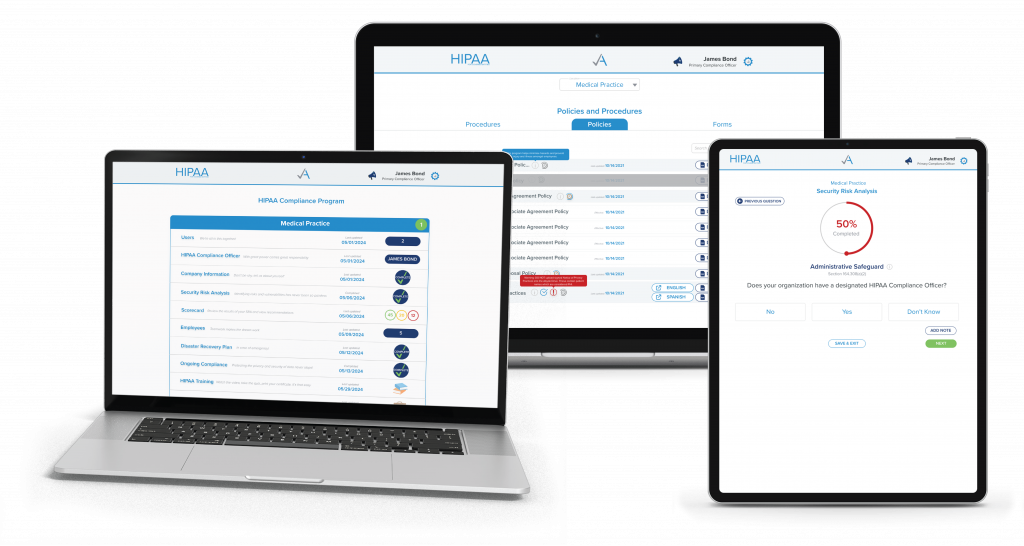

ABYDE FOR IRIS SOLUTIONS USERS

It's time for stress-free compliance.

  • EASIEST SOFTWARE YOU’LL EVER USE

    And if we’re being honest, easy is an understatement. All companies say it, but we are so confident in the simplicity of our software that we will prove it.

  • ‘HANDS OFF’ APPROACH

    We automate it all – from notifications about training to policy generation. Can you imagine not having to set your own reminders?! Go ahead, focus on your patients – we will ping you with the important stuff.

  • CUSTOMER SUCCESS TEAM LIKE NO OTHER

    We will meet you where you are – whether that’s by phone, chat, or email. It’s tough stuff in the tech space, but our customers love us as much as we love them.

  • STATE BY STATE, LAW BY LAW

    No matter what state your practice is in, our solution is for you — from sea to shining sea. We know our stuff and dedicate ourselves to staying on top of the latest state and federal changes so you don’t have to.

  • MORE THAN JUST SOFTWARE

    With us, you get more than policies and software. We offer Master Classes, newsletters, and more to keep you up to date. At the end of the day, we are proud to lead with education.

LATEST COMPLIANCE NEWS

Notice of Privacy Practices Update

2026 HIPAA Deadline: How to Update Your Notice of Privacy Practices (NPP) for SUD Records (42 CFR Part 2)

February 16, 2026 The latest HIPAA change is the latest updates to the Notice of Privacy Practices (NPP).        As of February 16, 2026, the newest version of the NPP must include further information about how Substance Use Disorder (SUD) Protected Health Information (PHI) is handled and secured. While this was initially ruled under the Biden administration in 2024, the updated content has seen significant changes, including the removal of proposed legislation that would treat reproductive healthcare PHI differently. However, while some states still have additional requirements for handling reproductive care PHI, those requirements were struck down at the federal level by a court ruling in 2025. Now that the deadline is here, it’s essential to understand what these changes actually mean for your practice. What’s Actually Changing in the Document? The Final Rule requires practices to update this document for patients (posted on the website and provided in-person) by February 16, 2026. Your practice must also review whether your state has additional legislation regarding reproductive healthcare PHI. Expanded Scope for SUD Information: SUD records must now be included in the NPP for all Covered Entities, regardless of whether the practice focuses specifically on SUD treatment. Standard Disclosure Language: The notice must explicitly state how the practice discloses SUD records for Treatment, Payment, and Healthcare Operations (TPO). Legal Proceeding Protections: The NPP must state that SUD records cannot be disclosed in legal proceedings without specific written patient consent or a formal court order. Single consent for TPO: The rule does allow patients to sign one consent for all future uses/disclosures of TPO. Previously, SUD records were discussed in a separate document for patients to review. Fundraising Opt-Outs: If your practice uses SUD records for fundraising communications, the NPP must clearly provide patients with the opportunity to opt out. For example, if a rehabilitation center is seeking to raise money for a new facility, it cannot reach out to former patients who have clearly opted out. Redisclosure Warning: The notice must highlight that once PHI (including SUD records) is shared with an outside party, it may be subject to redisclosure by the recipient. In other words, once it’s shared, it’s tough to control how it is shared again by third parties. Universal Accessibility: To remain compliant, practices must ensure the NPP is accessible to all patients, which includes providing translated copies. State-Specific Requirements: Depending on your state, additional protections for reproductive health PHI may still be in place. Where do I start? First, ensure your Notice of Privacy Practices (NPP) is already specific to your practice. Your final notice must be specific, include your office address, and provide clear contact information for your Compliance or Privacy Officer. To remain compliant, this notice must also be prominently displayed on your website so patients can easily access and understand their rights. Your NPP should now include a section that addresses these SUD records directly. The federal government provides model language similar to this: When applicable, we may use or disclose 42 CFR Part 2 substance use disorder records for treatment, payment, and health care operations as permitted by law. Part 2 records will not be used or disclosed in legal or administrative proceedings against you without your specific written consent or a court order. Your NPP should now include a section that mentions fundraising as well. The federal government provides model language similar to this: If we were to use or disclose substance use disorder records protected by 42 CFR Part 2 in connection with fundraising, you have the right to opt out of receiving fundraising communications in advance, before any such communications are sent. Simplify Compliance Updating your NPP can feel like just another complicated task on an already full plate. For practices where you’re wearing many hats, finding the resources for a legal deep-dive is tough. The simplest way to handle the February 16, 2026, deadline is to lean on experts. Abyde has already done the heavy lifting, automating the necessary HIPAA and SUD record updates so you can focus on what you do best: take care of patients. Reach out to our team of experts to learn more about HIPAA updates affecting your practice. Disclaimer: This post is for informational purposes only and does not constitute legal advice. Health care privacy laws are subject to frequent change and vary by state. Consult with a qualified health care attorney or compliance officer to ensure your Notice of Privacy Practices meets all current federal and state requirements.

Read More »
IT HIPAA compliance

“We Have IT”: Why That Doesn’t Mean You’re HIPAA Compliant

January 29, 2026 As a healthcare practice, your primary focus is patient care. You’ve likely hired an IT security team to keep your systems running smoothly. It feels like the final piece of the HIPAA compliance puzzle, right? Having an IT team doesn’t automatically make you HIPAA compliant. HIPAA requires documented administrative, physical, and technical safeguards, like a Security Risk Analysis (SRA), written policies and procedures, and ongoing HIPAA training for your workforce. While having an IT team is strongly recommended to keep your patients’ Protected Health Information (PHI) safe, it’s only the tip of the iceberg. HIPAA Requires Documentation (Not Just Fixes) While your IT team can assist with ensuring the technical side of HIPAA is in shape, like installing firewalls, antivirus software, encryption tools, and more, they might not know all of the legalese that comes along with HIPAA. In the world of HIPAA compliance requirements, if it isn’t documented, it didn’t happen. Your excellent IT team can get your network back online in record time, but the Office for Civil Rights (OCR) doesn’t just want to know that you’re back up and running; it wants a documented process for how your practice handles similar situations. That’s why extensive documentation is at the foundation of a compliant practice. The SRA reviews potential technical, administrative, and physical vulnerabilities your practice may face. HIPAA policies and procedures dictate how your office handles everything from a patient requesting their records to terminating an employee’s access on their last day. If your practice is investigated, the OCR won’t just look at your firewall; they’ll also ask to see your SRA, policies, and procedures. If your practice has nothing documented, “we have an IT guy” won’t save you from a fine. HIPAA Physical Safeguards Go Beyond the Firewall IT teams can get serious about their hardware, but the physical safeguards your practice must implement to be HIPAA compliant don’t stop at your tech stack. HIPAA physical safeguards include anything that serves as a barrier to the secure handling of PHI. At the end of the day, make arming the door alarm part of your closing routine to help protect PHI after hours. IT teams focus on digital support, but they can’t remotely verify that your staff has engaged your physical safeguards. No code can fix it when someone leaves a paper chart on the counter. HIPAA Training Requirements and the Human Element Your IT team can build the tallest digital fortress in the world, but they can’t stop an employee from leaving the front door unlocked. HIPAA compliance isn’t a software package; it’s a culture. While your IT team manages the technical safeguards, your staff is responsible for their behavior. Think of it this way: IT can block social media on your office network, but they can’t reach into a staff member’s pocket and stop them from posting about a patient on their personal phone. Technical safeguards are useless if your team doesn’t understand its individual responsibility to keep PHI secure. That’s why thorough HIPAA training and cultivating a culture of compliance are the real keys to success for your practice – and they happen to be things your IT team can’t patch or automate. IT Security and HIPAA Compliance: Working in Parallel Strongly consider an IT team to help your practice meet technical HIPAA requirements. However, your IT team can’t fulfill all the HIPAA requirements for your practice. That’s why the best solution is to use innovative compliance software alongside an IT company. Intelligent compliance platforms can generate dynamic documentation, pinpoint vulnerabilities with an intuitive SRA, and send out engaging training to staff. With these two working in tandem, you empower your staff, and you can feel confident that your practice complies with HIPAA. Want help turning HIPAA requirements into clear documentation, an SRA, and trackable training? Talk with our team to see how Abyde supports your practice.

Read More »

READY TO BE STRESS-FREE?