Skip to content
  • About Us
    • Who We Serve
  • Solutions
    • HIPAA for Covered Entities
    • OSHA for Healthcare
    • HIPAA for Business Associates
    • SRA for Covered Entities
    • Abyde Incident Response Program
    • Abyde Reseller Program
  • Resources
  • News
  • Events
  • Partners
  • Contact Us
  • Login
    • HIPAA for Covered Entities
    • OSHA for Healthcare
    • HIPAA for Business Associates
    • SRA for Covered Entities
SIGN UP
BOOK A DEMO

Royal Blunder: What the Kate Middleton Breach Teaches Us About Patient Privacy

April 5, 2024

Today, we’re talking about some international news. 

Once again, get your passport ready, because we’re taking a trip to the land of Big Ben, Buckingham Palace, and of course, the British monarchy. 

The British monarchy, spanning over 1200 years, has long been a symbol of the United Kingdom. 

You might have heard a lot of buzz about Kate Middleton’s health concerns over the last several months, with intense interest and curiosity regarding her recent absence from the public. 

People searching for answers became pandemonium, and rumors flourished, with millions rabidly looking for answers. 

Weeks after the introduction of  ‘KateGate’, the Princess of Wales addressed the public, in a heartfelt video message, revealing her recent cancer diagnosis. 

However, this personal update was unable to be done on her terms. Hospital staffers searched for her private medical records, violating the princess’s privacy. 

Today, we’re talking about a topic that hits close to home for everyone: that everyone, including royalty, deserves their Protected Health Information (PHI) to be secure. 

A Royally Big Problem

As a result of the media frenzy regarding the princess’s whereabouts, there was an unfortunate breach of protocol, with her information being searched for by three hospital staffers at the London Clinic after her surgery in January. 

These staffers have received disciplinary action and have been suspended. 

The CEO of the London Clinic, Al Russell has released a statement on the matter, “There is no place at our hospital for those who intentionally breach the trust of any of our patients or colleagues.”

The United Kingdom and Europe have similar legislation to HIPAA, protecting the privacy of its citizens, to learn more about their laws, read this linked article!

An investigation was opened up by the Information Commissioner’s Office, or ICO. Similar to America’s Office for Civil Rights, or OCR, the ICO investigates data protection violations and has the power to enforce laws. 

They received a breach report at the end of March, and more information is soon to come. 

However, Kate Middleton is no stranger to healthcare breaches. 

A similar breach occurred over a decade ago when she was pregnant with her first child. When she was hospitalized for morning sickness, medical staff accidentally shared detailed medical information with callers they thought were Queen Elizabeth and (now King) Prince Charles. These callers weren’t royalty at all, but radio hosts! 

What can we learn from this? 

While we don’t have a monarchy stateside, it does serve the valuable lesson that even members in the public eye deserve their protected health information to be private. 

Ensure your practice has access controls set up, ensuring that information is only accessible to the ones that need it. 

Additionally, ensure staff is properly trained, knowing best practices in any situation. 

The Kate Middleton incident serves as a stark reminder of the constant vigilance required to safeguard patient privacy. By learning from past mistakes and implementing extensive security measures, like compliance software like Abyde, healthcare practices can create a culture of compliance. This culture of compliance empowers staff to make informed decisions and protect health information.

To see how your compliance currently stands, email us at info@abyde.com and schedule a consultation here.
RECENT POSTS

  • OSF Healthcare HIPAA Settlement
    What OSF Healthcare's Ransomware Fine Teaches Every Practice About SRAs
  • Spencer Gifts HIPAA Fine
    Spencer Gifts HIPAA Settlement: Ransomware, Risk Analysis, and What Comes Next
  • OCR Ransomware Settlements
    OCR Ransomware Settlements: 4 Massive HIPAA Fines from April 2026 & How to Avoid Them
PrevPreviousWhat’s the GDPR?: Your Guide to EU Data Privacy
NextBeyond the Law: The Ethical Importance of HIPAA ComplianceNext

Related posts

OSF Healthcare HIPAA Settlement
Abyde News, Fines, HIPAA

What OSF Healthcare’s Ransomware Fine Teaches Every Practice About SRAs

August 5, 2026 Penelope Schweitzer No comments yet

August 5, 2026 The latest HIPAA fine is another clear reminder that ransomware attacks are, unfortunately, here to stay in the healthcare industry. A settlement involving the OSF Healthcare System was recently announced by the Office for Civil Rights (OCR). As an enterprise healthcare provider in the midwest, the organization serves 174 locations, including 16 hospitals – a prime target for a ransomware attack.    So, what happened?  In April 2021, OSF discovered that they joined the unlucky club of ransomware victims when a malicious actor deployed Nephilim, a ransomware strain made to target larger organizations. Once the ransomware infected OSF systems, the hacker demanded payment or patient Protected Health Information (PHI) would be leaked online. In this attack, sensitive information like financial account information, driver’s license numbers, medical record numbers, and more, were all exposed. Over 53,000 patient records were exposed in this attack.  When ransomware attacks in healthcare have soared 278% in recent years, it’s more of a when then an if your organization doesn’t have the right safeguards in place.  While the breach was discovered in April, OSF healthcare reported the breach to the OCR in October. The OCR took it from there, digging into what precautions (or lack thereof) let this happen.  What did the OCR discover? If you’ve read any of our other fine breakdowns, you already know where this is going: another missing Security Risk Analysis (SRA).  The SRA is a required document every HIPAA-regulated entity (ie: every practice and their Business Associates that handle patient information) needs to complete. The SRA is a thorough review of the physical, technical, and administrative safeguards in place to prevent PHI ending up in the wrong hands. While the OCR didn’t specify exactly how the ransomware got into OSF’s system, a technical safeguard vulnerability was very likely the entry point. A proactive SRA could have flagged that gap before it turned into a major breach. In addition to missing this required documentation, OSF also took too long to report the breach to the OCR and notify affected patients. This is a direct violation of the Breach Notification Rule, which requires organizations to notify patients within 60 days of a discovered breach. Moreover, since the breach impacted more than 500 patients, OSF was also required to report this breach to the OCR within 2 months as well. Time is of the essence in every component of a breach, from securing systems to ensuring affected parties are aware to protect themselves and an over five month delay was unacceptable in the eyes of the OCR.    What was the result?  OSF’s settlement tops the list as the largest fine of the year, coming in at $552,250, plus government monitoring for the next two years.  It’s very important to note that this breach occurred in 2021, meaning that over five years were spent from the initial breach, to investigations, to the public press releases. Also, the average cost of a healthcare breach is over 7 million dollars –  from implementing secure systems, notifying patients, legal fees, and more. The Takeaway While the settlement payment and Corrective Action Plan (CAP) are just the cherries on top, this experience was a tremendous cost of time, money, and resources, highlighting the importance of making sure everything is secure before a situation occurs.  So, when was the last time you looked at your SRA? It’s time to seriously analyze your current compliance posture. Ransomware groups don’t check whether you’re a small dental office or a 16-hospital health system before they attack, they check whether the door was left open. Time and again, OCR’s findings come back to the same root cause: organizations can’t secure what they haven’t even identified as a problem. Looking to review your current compliance standings? Meet with our team of experts for a complimentary educational consultation. 

Ransomware in Healthcare practices
Abyde News, Best Practices, HIPAA

When Ransomware Meets HIPAA: Turning a Cyber Scare Into a Plan

November 6, 2025 Penelope Schweitzer No comments yet

November 6, 2025   The lights flicker. Your EHR freezes. A skull-and-crossbones pops up with a countdown, and your team can’t access patient charts. Appointments grind to a halt. No, it’s not a scene from a horror movie you watched on Halloween; it’s what a real ransomware attack can look like for a healthcare practice. Ransomware is a growing threat in healthcare because it goes after what you rely on most: access to patient information. Attackers lock you out of your own systems and demand payment, all while putting Protected Health Information (PHI) at risk. The good news? With the proper safeguards, training, and a plan in place, your practice can respond quickly and minimize the damage. What is a Ransomware Attack? Ransomware is malicious software, or malware, that deliberately seizes records in exchange for a payment, usually demanding enormous amounts of money.  The Change Healthcare Breach, the most significant HIPAA breach on record, highlighted the devastating scale of these attacks. This single incident impacted nearly 200 million Americans! It involved a $22 million bitcoin ransom paid to the hackers after the initial attack, as well as billions of dollars in downtime and recovery. That’s how serious these incidents can get. When PHI is worth 10 to 20 times more than a credit card on the black market, it puts healthcare providers in the crosshairs of malicious bad actors. A credit card is like having a single slice of pizza, and who stops at one? A patient’s PHI gives hackers the whole pie. Instead of cheesy goodness, it’s a compliance nightmare for your practice.  Ransomware attacks have increased rapidly in the healthcare sector in recent years, with a 264% rise in large breaches caused by ransomware crimes. The big problem is that these threats are Pandora’s box, incredibly difficult to contain once they’ve begun.  How can I stop a Ransomware Attack?  You can’t guarantee it will never happen, but you can take the proper steps to minimize risks significantly.  First, ensure staff are adequately trained on email safety. We hate to break it to you, but that “Free vacation when you send an Apple gift card!” email is probably too good to be true. Most attacks start with a suspicious email that’s opened by unknowing employees. Ensure staff are aware of common phishing signs and know how to report suspicious activity correctly.  Also make sure that all proper technical safeguards, such as firewalls and encryption, are current and fully operational to secure patient data. Implement multi-factor authentication (MFA) for all logins to provide an additional layer of protection. While your password acts as a door, MFA acts as a key, keeping patient PHI secure.  No practice is 100% safe, but a solid Disaster Recovery Plan empowers your team to actually know what to do if ransomware hits and gives actionable items like quickly taking the infected device offline and involving your IT team immediately. And if you’ve got good backups in place, you can protect your patients and get your practice back on track much faster!   Keeping Your Practice Ransomware Ready Ransomware isn’t just a one-time jump scare; it’s an ongoing risk. But when you combine staff training, up-to-date safeguards, MFA, and a thorough response plan, your practice goes from vulnerable to prepared. The best part? You don’t have to figure it out alone! Smart compliance solutions can help you stay on top of requirements, document your actions, and support you if something does go wrong. Ready to learn more? Meet with a HIPAA compliance expert today

HIPAA Compliance Email Safety
Best Practices, Cybersecurity, HIPAA

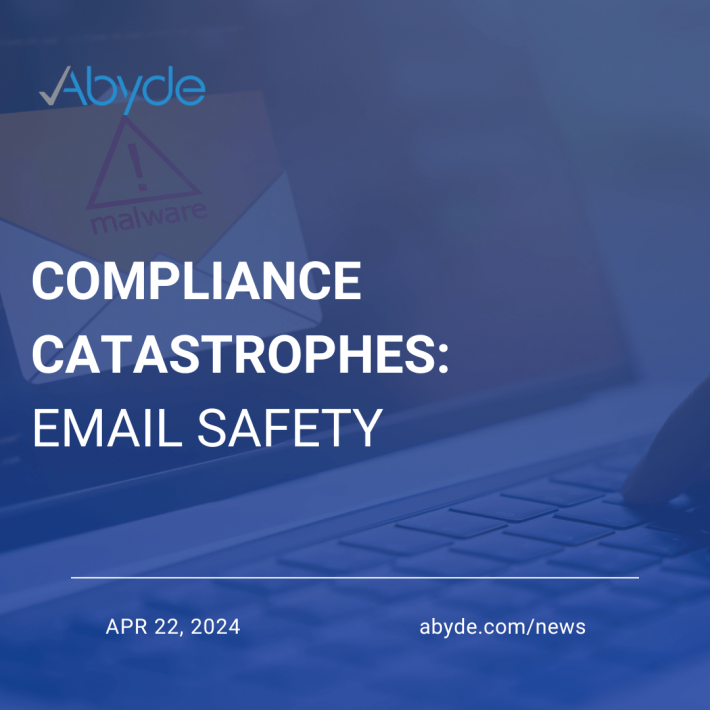
Compliance Catastrophes: Email Safety

April 22, 2024 Gaurav Modi Comments Off on Compliance Catastrophes: Email Safety

April 22, 2024 Good morning! We hope we can cheer up your Monday blues with the announcement of our new educational series, Compliance Catastrophes: real-ish world examples of nightmare scenarios!  Throughout this week, we’ll be releasing blogs and videos on common breaches of Protected Health Information (PHI) in healthcare, giving you the tips you need to stay secure.  We’re starting our series with one of the most common HIPAA breaches: email scams.  Email scams are very prevalent, with 91% of cyberattacks beginning with a phishing email. Phishing attempts are the most common form of cybercrime, with 3.4 BILLION spam emails sent daily.  Now, before we get too far, let’s clear up any misconceptions. Phishing attempts are unfortunately not a Saturday night getaway on a boat with your friends catching fish, it’s much more like casting a lure of fake urgency or importance to try and ‘fish’ for personal information, like PHI. You might think that you could never fall for a phishing scam, but let me tell you, it happens quite often.  Let me introduce you to the star of the week, Catastrophe Cathy.  A One-way Ticket to a Breach Cathy was scrolling through her email, and she couldn’t believe her eyes! Her boss sent her an email offering her a week’s vacation to Italy! All she had to do was claim it by clicking the link listed at the bottom of the email.  She was sold! It looked real; it said it was from her boss, Bob, and it even had his email signature!  As she clicked the link, the malware began to work its nefarious magic – infecting her computer and getting access to PHI.  Her dreams of seeing the Leaning Tower of Pisa came crashing down. Once she realized there was no trip. She panicked! What was she going to do?  Email Safety 101 Now, we can be like Cathy if we aren’t careful when checking our emails!  Falling for these phishing scams affects over 300,000 people a year, yielding over $50 million in losses.  First, an always good rule of thumb: If it’s too good to be true, it’s not. Sorry, or scusa (sorry in Italian) Cathy!  Next, always check who is sending the email. While it looked like it came from Bob the Boss, if she looked at the email address, she would have seen it came from Stevethescammer@email.com! Hackers pretending to be someone else at your organization is a very common practice known as spoofing.  Lastly, if you see any odd links or attachments, never click them, report them as spam, delete them, and, if applicable, forward them to your organization’s phishing email!  Phishing scams have also made a recent detrimental impact on healthcare. The OCR settled its first phishing cyber attack investigation, costing the Lafourche Medical Group $480,000!  Reel in Control Now, if you find yourself falling for an email scam, the first thing you need to do is to alert your team. You might be embarrassed, but it’s brave to admit you’re wrong, ensuring others don’t fall for a similar attack, too.  The most important step right now is to disconnect your device from the internet. Think of it like putting up a “closed for business” sign. This cuts off the hackers’ access and prevents them from finding more information on your network.  Loop in your IT team or IT provider, and follow company procedures for a cyber attack. Of course, notify patients affected by the breach, and report the breach in your Abyde software and to the OCR. Also, since it is a phishing attempt, you can report it to the FTC.  To learn more about common breaches, stay tuned to our blogs and videos this week! Follow us on social media to be the first to see the latest compliance news, and if you have any questions, email us at info@abyde.com. 

  • Facebook
  • Instagram
  • LinkedIn
  • YouTube
Abyde Logo

1.800.594.0883 | info@abyde.com

Automated HIPAA and OSHA Compliance

Our Reviews

From Our Blog
  • Don’t Get Caught Off Guard: HIPAA Audits are Back!
  • Don’t Be a Statistic: Why OSHA Compliance Matters in Healthcare
  • What Money Doesn’t Cover: The True Price of HIPAA Non-Compliance
  • HIPAA: It’s Not Just a Training – Your Guide to Continuous Compliance
Solutions
  • HIPAA for Covered Entities
  • OSHA for Healthcare
  • HIPAA for Business Associates
  • SRA for Covered Entities
  • Abyde Incident Response Program
  • Abyde Reseller Program
Resources
  • News
  • Events
  • Partners
  • HIPAA Badges
  • OSHA Badges
  • Learning Center
  • Compliance FAQs
Company
  • About Us
  • Who We Serve
  • Pricing
  • Contact Us
  • Newsletter
  • Jobs
  • COPYRIGHT © 2026 ABYDE
  • |

  • TERMS & CONDITIONS
  • |

  • PRIVACY POLICY
  • |

  • SECURITY MEASURES
  • |

  • E-SIGNATURE TERMS