Skip to content
  • About Us
    • Who We Serve
  • Solutions
    • HIPAA for Covered Entities
    • OSHA for Healthcare
    • HIPAA for Business Associates
    • SRA for Covered Entities
    • Abyde Incident Response Program
    • Abyde Reseller Program
  • Resources
  • News
  • Events
  • Partners
  • Contact Us
  • Login
    • HIPAA for Covered Entities
    • OSHA for Healthcare
    • HIPAA for Business Associates
    • SRA for Covered Entities
SIGN UP
BOOK A DEMO

Top Mistakes of Business Associates in Healthcare: How to Avoid Partnership Pitfalls

March 13, 2024

Hi Business Associates (BAs)! 

We know that working with healthcare practices adds the stress of securing the Protected Health Information (PHI) of patients. Running a business and protecting patients can be tough, but it’s a requirement under HIPAA. 

This shared responsibility is key to keeping your business compliant, allowing you to have a successful business, happy partners, and of course, safe patients. 

Here are some of the most common compliance violations BAs make, and how you can avoid them. 

Dude, Where’s My Business Associate Agreement? 

The first thing a Business Associate needs to do is sign a Business Associate Agreement (BAA) when working with a Covered Entity (CE). BAAs are a game plan for our business alongside healthcare practice. With a proper BAA, your organization has documentation of your shared responsibilities to keep PHI secure. 

If there’s anything you need to know about compliance, it’s to document everything!

This BAA includes important information about permitted uses and disclosures of PHI, safeguards that the BA is expected to establish, Breach Notification requirements, training requirements and more. 

Now, this map of your partnership seems like a pretty easy thing to do, especially because it takes some liability off of your shoulders. 

However, one of the most common violations of HIPAA for BAs is not having this agreement documented.

There have been millions of dollars in fines that stem from one simple thing: not having a BAA. It’s a simple step your business has to take, and with Abyde, we make it easy.

With our software, we will draft a personalized BAA for your organization. All you have to do is sign it and send it off to your CE partner. Worried about losing this BAA? Don’t worry! It lives in the software having this documentation readily available for your business.

Getting Schooled

A Lack of training is another top mistake for BAs. Once again, as a BA, it is imperative to be aware and educated on compliance. While compliance training might not exactly be as exciting as a Rocky montage running around Philly, it is very important, and when done right, can be fun. Abyde nails entertaining training with our interactive material, simplifying complicated topics into top-notch training. 

Once again, training is vital for BAs, and when not completed, the consequences can be severe. When you violate HIPAA rules, like not training, the minimum fine is $137 per incident. Something like that can add up pretty quickly. 

Additionally, training is so important in promoting a culture of compliance, ensuring all employees know the essential role they play in your business.

Breach Bandits

Unfortunately, breaches are common in healthcare. While it is imperative to take proper precautions against breaches, like having an IT company’s assistance, controlled access, and more, it can still happen. Sometimes, no matter how hard you secure your business, breach bandits still find a way through your security. 

While it might happen to you, you can always control how you handle the situation. Before a breach even occurs, you need to take the proper cybersecurity precautions, and also complete a Security Risk Analysis (SRA). 

After a breach, it is required to follow the Breach Notification Rule of HIPAA. The Breach Notification defines what your business needs to do if it is impacted by a breach, including how it needs to be reported and how it must be shared with affected patients. 

The consequences of improperly handling a breach can be catastrophic, with major fines affecting your business. 

For example, the first ransomware attack ruled on by the OCR impacted a BA. This Business Associate was caught in the crosshairs of a ransomware attack and was fined $100,000 due to their lack of a SRA and having no policies and procedures in order. 

Now, dun dun dun! That’s where Abyde steps in again. Our software includes a simple SRA for your business to complete, going through all OSHA requirements in a questionnaire that takes minutes to complete. Well, you might now be wondering: What about policies and procedures? How do I quickly write those? I don’t know what I need? Well, the Abyde software has dynamically generated policies and procedures for your practice, drafted in seconds. 

Overall, your friends at Abyde know that running both a successful business AND ensuring the protection of patients’ data can be complicated, and that’s why we’re here to help. 

Abyde is the simple solution for all of your compliance concerns, with our intuitive software making compliance easy. 

To learn more about how Abyde can eliminate your business’ compliance worries, email us at info@abyde.com or schedule a consultation here.
RECENT POSTS

  • OSF Healthcare HIPAA Settlement
    What OSF Healthcare's Ransomware Fine Teaches Every Practice About SRAs
  • Spencer Gifts HIPAA Fine
    Spencer Gifts HIPAA Settlement: Ransomware, Risk Analysis, and What Comes Next
  • OCR Ransomware Settlements
    OCR Ransomware Settlements: 4 Massive HIPAA Fines from April 2026 & How to Avoid Them
PrevPreviousA to Z: A Compliance Dictionary
NextChange Healthcare Breach: What We Know NowNext

Related posts

OSF Healthcare HIPAA Settlement
Abyde News, Fines, HIPAA

What OSF Healthcare’s Ransomware Fine Teaches Every Practice About SRAs

August 5, 2026 Penelope Schweitzer No comments yet

August 5, 2026 The latest HIPAA fine is another clear reminder that ransomware attacks are, unfortunately, here to stay in the healthcare industry. A settlement involving the OSF Healthcare System was recently announced by the Office for Civil Rights (OCR). As an enterprise healthcare provider in the midwest, the organization serves 174 locations, including 16 hospitals – a prime target for a ransomware attack.    So, what happened?  In April 2021, OSF discovered that they joined the unlucky club of ransomware victims when a malicious actor deployed Nephilim, a ransomware strain made to target larger organizations. Once the ransomware infected OSF systems, the hacker demanded payment or patient Protected Health Information (PHI) would be leaked online. In this attack, sensitive information like financial account information, driver’s license numbers, medical record numbers, and more, were all exposed. Over 53,000 patient records were exposed in this attack.  When ransomware attacks in healthcare have soared 278% in recent years, it’s more of a when then an if your organization doesn’t have the right safeguards in place.  While the breach was discovered in April, OSF healthcare reported the breach to the OCR in October. The OCR took it from there, digging into what precautions (or lack thereof) let this happen.  What did the OCR discover? If you’ve read any of our other fine breakdowns, you already know where this is going: another missing Security Risk Analysis (SRA).  The SRA is a required document every HIPAA-regulated entity (ie: every practice and their Business Associates that handle patient information) needs to complete. The SRA is a thorough review of the physical, technical, and administrative safeguards in place to prevent PHI ending up in the wrong hands. While the OCR didn’t specify exactly how the ransomware got into OSF’s system, a technical safeguard vulnerability was very likely the entry point. A proactive SRA could have flagged that gap before it turned into a major breach. In addition to missing this required documentation, OSF also took too long to report the breach to the OCR and notify affected patients. This is a direct violation of the Breach Notification Rule, which requires organizations to notify patients within 60 days of a discovered breach. Moreover, since the breach impacted more than 500 patients, OSF was also required to report this breach to the OCR within 2 months as well. Time is of the essence in every component of a breach, from securing systems to ensuring affected parties are aware to protect themselves and an over five month delay was unacceptable in the eyes of the OCR.    What was the result?  OSF’s settlement tops the list as the largest fine of the year, coming in at $552,250, plus government monitoring for the next two years.  It’s very important to note that this breach occurred in 2021, meaning that over five years were spent from the initial breach, to investigations, to the public press releases. Also, the average cost of a healthcare breach is over 7 million dollars –  from implementing secure systems, notifying patients, legal fees, and more. The Takeaway While the settlement payment and Corrective Action Plan (CAP) are just the cherries on top, this experience was a tremendous cost of time, money, and resources, highlighting the importance of making sure everything is secure before a situation occurs.  So, when was the last time you looked at your SRA? It’s time to seriously analyze your current compliance posture. Ransomware groups don’t check whether you’re a small dental office or a 16-hospital health system before they attack, they check whether the door was left open. Time and again, OCR’s findings come back to the same root cause: organizations can’t secure what they haven’t even identified as a problem. Looking to review your current compliance standings? Meet with our team of experts for a complimentary educational consultation. 

Spencer Gifts HIPAA Fine
Abyde News, Fines, HIPAA

Spencer Gifts HIPAA Settlement: Ransomware, Risk Analysis, and What Comes Next

June 19, 2026 Penelope Schweitzer No comments yet

June 19, 2026   Quick Guide:  The Office for Civil Rights issued a major fine towards Spencer Gifts benefits plan. This fine reinforces that all HIPAA-regulated entities must have a thorough compliance program.    The Stats You Need to Know 76%: The percentage of large healthcare breaches now caused by hacking/IT incidents. $450,000: Financial settlement of this enforcement. 10,023: The number of individuals were impacted in this breach.  264%: The increase in ransomware-related breaches reported to the OCR since 2018.   When you think about Spencer’s, you likely picture the staple mall store with pop culture novelty gifts, not the latest HIPAA settlement enforcement headline.  Spencer Gifts LLC Flexible Benefits and Welfare Benefit Plans, or their employee benefits plan, reached a settlement with the Office for Civil Rights for $450,000 and a 2 year Corrective Action Plan (CAP).  This fine is a reminder that Covered Entities include all parties that create and utilize patient data, including health care plans. While they might not see patients traditionally, they still are responsible for keeping Protected Health Information (PHI) secure.    What Happened?   In response to employee complaints regarding access to their employee benefits portal, Spencer Gifts Health Plan discovered their systems were infiltrated with ransomware in November 2021. Malicious actors encrypted over 10,000 individuals’ PHI and demanded a ransom. The exposed data included names, phone numbers, social security numbers, and more, putting employees at risk.  The breach was reported in January 2022. After years of investigation, it was settled that the plan failed to meet basic HIPAA Security Rule requirements proactively.    The Compliance Gaps A common misconception is that an organization faces a financial penalty due to a breach. While the breach serves as the catalyst for the investigation, the OCR is looking to see if an organization has a thorough compliance program in place and made a genuine effort to protect patient data.  For instance, the health plan did not complete a Security Risk Analysis (SRA). This required assessment identifies all technical, administrative, and physical safeguards (and vulnerabilities) across your organization. By completing this document, your organization can address concerns before they become an issue. There’s no way to know where risks are unless they are properly reviewed.  Additionally, the plan did not have sufficient policies and procedures, nor trained staff adequately. Without sufficient policies and training, staff are left without the tools to recognize and respond to HIPAA threats before they escalate. As a result, Spencer Gifts now faces $450,000 in penalties and two years of government monitoring to ensure those missing requirements are finally implemented. And that figure doesn’t account for the years of investigation, legal fees, breach notification costs, and operational disruption that preceded the settlement.   The Biggest Takeaway This case isn’t only a lesson for retail organizations’ health plans, but it’s a warning for every HIPAA-regulated entity. The OCR can and will investigate any organization exposed for failing to meet HIPAA requirements, including small medical practices To be prepared before a cyberattack occurs, make sure your organization has: A completed and current Security Risk Analysis. A trained workforce that knows how to handle PHI Accessible policies and procedures staff can actually reference. An up-to-date compliance program.  Ready to strengthen your compliance program? Schedule a free educational consultation with our team today.

OCR Ransomware Settlements
Abyde News, Fines, HIPAA

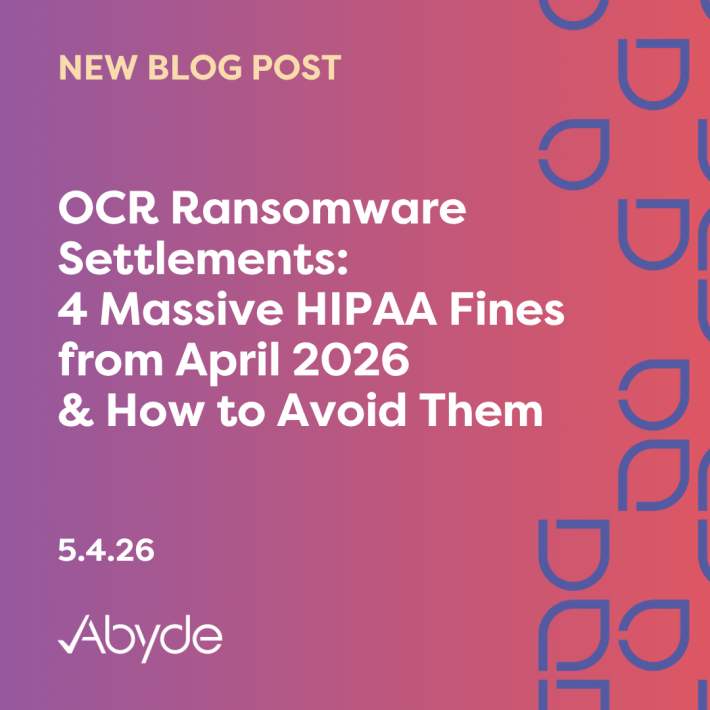
OCR Ransomware Settlements: 4 Massive HIPAA Fines from April 2026 & How to Avoid Them

May 4, 2026 Penelope Schweitzer No comments yet

May 4, 2026   Quick Guide:  The Office for Civil Rights (OCR) just issued a massive wake-up call, announcing four simultaneous settlements totaling $1,165,000. The Stats You Need to Know 76%: The percentage of large healthcare breaches now caused by hacking/IT incidents. 427,000+: Total number of patients impacted across these four recent settlements. 264%: The increase in ransomware-related breaches reported to the OCR since 2018. The Office for Civil Rights (OCR) just announced a flurry of investigation settlements. At the root of the four that were announced: ransomware. Ransomware attacks continue to target healthcare facilities. As of last year, the OCR discovered that 76% of large breaches are due to hacking and IT shortcomings. Unfortunately, healthcare information is a goldmine for hackers, exposing sensitive data that can lead to identity theft, financial fraud, and compromised patient care. Breakdown & Lessons Learned Regional Women’s Health Group (Axia) The first settlement was regarding the Regional Women’s Health Group (Axia), an OBGYN network across five states. In this case, the organization submitted a breach report following a cyberattack that exposed over 37,000 patients. The settlement resulted in a $320,000 fine and a 2-year Corrective Action Plan (CAP). The Lesson: The OCR didn’t just fine them for being hacked; they reached a settlement because the healthcare organization failed to conduct a “thorough and accurate” Security Risk Analysis (SRA). If you don’t know where your vulnerabilities are, you can’t patch them. Unfortunately, hackers counted on this negligence and exploited it.  Assured Imaging This was the largest of the four fines, affecting a staggering 244,813 individuals. When a ransomware infection hit their servers, Assured Imaging, a medical imaging enterprise, reported a breach to the OCR. After a long investigation (the initial cyberattack occurred in 2020), and resulted in a $375,000 settlement and a 2-year CAP.  The Lesson: Beyond the initial ransomware attack, it was discovered that Assured had never completed an SRA. Additionally, the organization did not notify patients within 60 days of discovery of the breach. This is a direct violation of the Breach Notification Rule, which aims to allow patients to take control and mitigate risks as quickly as possible.  Consociate Health Consciate Health is the only Business Associate (BA) fine in the four. BAs continue to be under the OCR’s microscope, such as potentially needing to follow stricter requirements when handling patient data. Their breach started with a phishing attack that eventually led to the encryption of systems holding data for over 136,000 people. The BA discovered the ransomware six months after the initial phishing attack. Upon the OCR’s further investigation, the SRA was found to be insufficient. The organization paid a $225,000 settlement and entered into a 2-year CAP.  The Lesson: Human error (phishing) is the most common entry point for ransomware. Constant employee training is just as important as a strong firewall. Additionally, just because a BA doesn’t directly work with patients doesn’t mean it isn’t their responsibility to keep patient data secure.  SG Health Plan Even employee benefit plans are regulated under the Health Insurance Portability and Accountability Act (HIPAA). SG Health Plan, associated with a Connecticut energy provider, reported that the data of 9,316 members were exposed following a ransomware attack. It was discovered that the organization did not complete an extensive SRA. The benefit plan entered a settlement with the OCR for $245,000 and a 2-year CAP.  The Lesson: This settlement highlights that HIPAA applies to corporate health plans just as much as it does to traditional healthcare providers. Additionally, every organization that handles Protected Health Information (PHI) must complete an SRA.  The Bottom Line The OCR isn’t fining practices for ransomware attacks, but for being ill-prepared.  However, it is easier said than done to ensure your organization is secure in protecting patient data and complying with HIPAA.  Proactively implementing the HIPAA Security Rule is your opportunity to mitigate the impacts of a cyberattack. Waiting until the ransom note appears on your screen is a million-dollar mistake. Want to see what you might be missing?  Run a 5-Minute HIPAA Gap Assessment and protect your practice today! 

  • Facebook
  • Instagram
  • LinkedIn
  • YouTube
Abyde Logo

1.800.594.0883 | info@abyde.com

Automated HIPAA and OSHA Compliance

Our Reviews

From Our Blog
  • Don’t Get Caught Off Guard: HIPAA Audits are Back!
  • Don’t Be a Statistic: Why OSHA Compliance Matters in Healthcare
  • What Money Doesn’t Cover: The True Price of HIPAA Non-Compliance
  • HIPAA: It’s Not Just a Training – Your Guide to Continuous Compliance
Solutions
  • HIPAA for Covered Entities
  • OSHA for Healthcare
  • HIPAA for Business Associates
  • SRA for Covered Entities
  • Abyde Incident Response Program
  • Abyde Reseller Program
Resources
  • News
  • Events
  • Partners
  • HIPAA Badges
  • OSHA Badges
  • Learning Center
  • Compliance FAQs
Company
  • About Us
  • Who We Serve
  • Pricing
  • Contact Us
  • Newsletter
  • Jobs
  • COPYRIGHT © 2026 ABYDE
  • |

  • TERMS & CONDITIONS
  • |

  • PRIVACY POLICY
  • |

  • SECURITY MEASURES
  • |

  • E-SIGNATURE TERMS