Skip to content
  • About Us
    • Who We Serve
  • Solutions
    • HIPAA for Covered Entities
    • OSHA for Healthcare
    • HIPAA for Business Associates
    • SRA for Covered Entities
    • Abyde Incident Response Program
    • Abyde Reseller Program
  • Resources
  • News
  • Events
  • Partners
  • Contact Us
  • Login
    • HIPAA for Covered Entities
    • OSHA for Healthcare
    • HIPAA for Business Associates
    • SRA for Covered Entities
SIGN UP
BOOK A DEMO

What Does ‘Information Blocking’ Mean?

October 15, 2020

If you’re at all familiar with the 21st Century Cures Act, you may have heard the term ‘information blocking’ tossed around. Even if you’re not, you may be familiar with the ongoing healthcare battle to prevent information blocking and more effectively share patient information. If you’re not familiar with any of these things…well…keep reading anyways, if you’re an independent practice we promise this is going to be increasingly important information to know. 

A major goal of the Cures Act is to break down the barriers currently erected to interfere with, prevent, or discourage the access, exchange, or use of electronic Protected Health Information (ePHI) within the healthcare industry – otherwise known as information blocking. HIPAA outlines the specific ways information can be shared (and these rules still apply) but the statement of “sorry we can’t share that information because of HIPAA” is often applied incorrectly, and part of what the Cures Act hopes to correct.

Deliberately blocking information that should be shared with patients and other appropriate covered entities, such as with Health Information Exchanges (HIE’s), can prevent or delay proper treatment and ultimately reduces the effectiveness of patient care. Before the Cures Act rules go into effect (November 2, 2020), organizations must reevaluate or remove any barriers currently in place that constitute information blocking. Not 100% what that really means? You aren’t alone, which is why the Office of the National Coordinator for Healthcare Technology (ONC) has created a helpful cheat sheet for what does and does not qualify as information blocking.

There are some exceptions to what falls under the “information blocking” umbrella, including: 

  • Preventing Harm Exception – if a provider engages in practices that are reasonably necessary to prevent the harm of a patient or other individual.
  • Privacy Exception – when a provider does not complete a request for the purpose of protecting an individual’s privacy. 
  • Security Exception –  means that it will not be information blocking if the provider interferes with the access, exchange, or use of ePHI in order to protect the security of the data itself.
  • Infeasibility – if the provider does not fulfill a request due to the infeasibility of the request, for example, the provider cannot fulfill a request for access due to a natural disaster or internet service interruption. 
  • Health IT performance –  when a provider takes reasonably necessary steps to make health IT temporarily unavailable or to degrade the health IT’s performance in order to either achieve maintenance or improvements, be implemented in a consistent manner, and not occur for a period of time longer than is necessary to resolve any negative impacts. 
  • Content and manner – if a provider limits the content of its response to a request to access, exchange, or use ePHI or the manner in which it fulfills a request to access, exchange, or use ePHI.
  • Fees Exception – means that a provider can charge fees for accessing, exchanging, or using ePHI as long they are reasonably related to the provider’s costs of providing the type of access.  
  • Licensing – if a provider licenses interoperability elements for ePHI to be accessed, exchanged, or used. 

All of these exceptions are only permissible provided certain conditions are met.

In general, think of information blocking as refusing to share data even when there is no reason not to – i.e., none of these exceptions or regular privacy concerns apply. Where it gets tricky is when information sharing might – though the situation makes it unclear – violate HIPAA compliance regulations (really violate them, not just as an excuse). It’s always helpful to ask the experts in these circumstances – such as your HIPAA compliance program provider (*cough cough*). 
RECENT POSTS

  • Dental Practice HIPAA Settlement
    What Every Dental Practice Can Learn From the $140K Shen Smiles Settlement
  • Ambry Phishing Settlement
    $700K HIPAA Settlement: What the Ambry Genetics Phishing Breach Teaches Every Practice
  • Azul Vision Right of Access
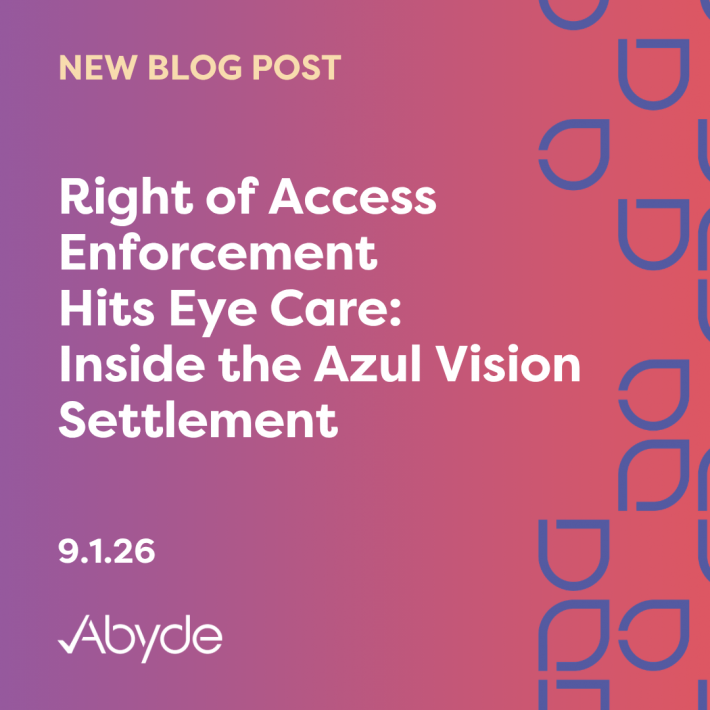
    Right of Access Enforcement Hits Eye Care: Inside the Azul Vision Settlement
PrevPreviousOCR Settles Ninth HIPAA Right of Access Investigation
NextState HIPAA Fines Add to Growing 2020 Fine TotalsNext

Related posts

Dental Practice HIPAA Settlement
Abyde News, Fines, HIPAA

What Every Dental Practice Can Learn From the $140K Shen Smiles Settlement

October 9, 2026 Penelope Schweitzer No comments yet

October 9, 2026 The latest HIPAA settlement doesn’t involve a hospital system or a massive ransomware attack. It involves a practice that probably looks a lot like yours. Shen Smiles is a solo dental practice in Drums, Pennsylvania. It started with a former patient’s complaint about getting their health records. It led to a broader OCR investigation and a $140,000 settlement. The lesson? Every HIPAA-regulated organization, big or small, can face enforcement.   What happened? Under federal law, patients must be given access to their records within 30 days, with one possible 30-day extension if the patient is notified in writing within the first 30 days. In April 2020, a former patient’s attorney filed a complaint with the Office for Civil Rights (OCR). The complaint alleged that the patient had requested their records multiple times without receiving access. The public documents don’t say when the first request was made. OCR’s investigation went beyond the original complaint. According to the resolution agreement, OCR found that patient records weren’t properly maintained and that staff hadn’t received formal HIPAA Privacy Rule training. OCR also said the practice couldn’t produce evidence that it had HIPAA policies and procedures in place, including for patient access requests, or that it had reasonably safeguarded patient information. During the investigation, the practice stated that it couldn’t provide the records because a workforce member had stolen them. The public documents don’t address whether a breach assessment was done. As a general rule, though, HIPAA presumes that an impermissible acquisition, access, use, or disclosure of unsecured patient information is a breach. A breach can require notifying HHS and affected patients, including steps patients can take to protect themselves. These are baseline requirements every covered entity is expected to have in place. Policies and training give a team a HIPAA playbook. Without one, staff at any practice may not know what to do when a patient asks for records or records go missing. OCR proposed a $140,000 civil money penalty in July 2024. Shen Smiles requested a hearing before an administrative law judge, but the two sides reached a resolution agreement in August 2026, before the hearing took place. Under the agreement, the practice agreed to pay $140,000. The agreement is not an admission of liability.   The Takeaway for Practices Patient access has been an OCR priority for years through its HIPAA Right of Access Initiative, and this case marks its 56th Right of Access enforcement action. It also took more than six years from complaint to resolution. As this case shows, a single complaint can lead to a broader look at your compliance program. Now is the time to ask: Do we have written HIPAA policies our team can find? Do we have a process to answer every record request within 30 days? Can we prove every team member has completed HIPAA training? If any of those gave you pause, now’s the time to fix it, before OCR comes asking. Looking for the first step? Meet with one of our compliance experts to see where you currently stand. 

Ambry Phishing Settlement
Abyde News, Fines, HIPAA

$700K HIPAA Settlement: What the Ambry Genetics Phishing Breach Teaches Every Practice

September 21, 2026 Penelope Schweitzer No comments yet

September 21, 2026   The HHS Office for Civil Rights (OCR) has announced its biggest HIPAA settlement of the year, reaching nearly a million dollars.  Ambry, a genetic testing and clinical genomics provider based in Aliso Viejo, California is at the center of this enforcement. A settlement was reached over a 2020 phishing attack that exposed the Protected Health Information (PHI) of more than 225,000 individuals. This settlement is a clear reminder that even large organizations trip up on HIPAA requirements.    What happened In January 2020, an employee email account at Ambry was compromised through a phishing attack.  The breach potentially exposed a wide range of PHI, including names, addresses, dates of birth, Social Security Numbers, financial details, and more. Ambry reported the breach to OCR in March 2020, which kicked off the investigation.    Where OCR found gaps OCR’s investigation identified several HIPAA Security Rule gaps, including: No accurate, thorough risk analysis of risks and vulnerabilities to ePHI No process for cutting off access to ePHI when an employee left or no longer needed access No unique user IDs for tracking who was accessing ePHI systems These are baseline HIPAA requirements that every Covered Entity and Business Associate is expected to have in place.   The settlement terms Ambry paid $700,000 and agreed to a two-year corrective action plan, under which it must: Complete a thorough risk analysis of ePHI confidentiality, integrity, and availability Build and execute a risk management plan addressing what that analysis turns up Review and update Security Rule policies and procedures as needed Implement unique user identification across all ePHI systems Train the whole workforce on those updated policies The takeaway for practices When 90% of healthcare hacks start with a successful phishing attempt, it’s key your team is aware of the role they play to keep data safe. Every practice should ask; Do we know exactly where our ePHI lives and how it moves through our systems? Do we have a current, documented risk analysis? Would we catch it fast if a former employee’s access wasn’t revoked? Looking for the first step of addressing these gaps? Meet with one of our compliance experts to see where you currently stand. 

Azul Vision Right of Access
Abyde News, Fines, HIPAA

Right of Access Enforcement Hits Eye Care: Inside the Azul Vision Settlement

September 1, 2026 Penelope Schweitzer No comments yet

September 1, 2026   The Office for Civil Rights (OCR) announced its 55th settlement under the HIPAA Right of Access Initiative, and this one is a good reminder that “we’ll get to it” is an easy shortcut to a massive financial penalty.   What happened Azul Vision, Inc., a California optometry enterprise healthcare provider, took nearly two years to provide a patient her healthcare records failed to give a patient timely access to her health records. She requested her records in January 2023. She didn’t actually receive them until January 2025, or two years later, and only after OCR opened an investigation following her complaint in April 2023.   The importance of Right of Access The HIPAA Privacy Rule’s Right of Access is straightforward: patients are entitled to their healthcare records within 30 days of a request, with one possible 30-day extension if needed.    The cost Azul Vision agreed to a two-year, OCR-monitored corrective action plan and paid $50,000. The corrective action plan requires the practice to: Review and revise its written policies and procedures for Privacy Rule compliance.  Regularly report to HHS a log of every PHI access request it receives, including when it came in and when it was resolved, Train all workforce members on right of access requirements and the practice’s own procedures.   Practical takeaways Have a documented, assigned process for access requests: not an informal “someone will handle it” arrangement. Track every request against the 30-day (or extended 60-day) clock: If nothing is timestamping requests, nothing is catching the ones that slip. Train staff specifically on right of access: this is a distinct Privacy Rule obligation from general HIPAA awareness, and it’s clearly one OCR is actively enforcing.   The bottom line A single records request that went unanswered turned into a $50,000 penalty, two years of federal monitoring, and a detrimental hit to the organization’s reputation. That’s a steep price for what really comes down to a missing process. If your team can’t answer “what happens the moment a patient asks for their records?” right now, that’s the gap to close before your practice ends up as OCR’s next enforcement case. Want a streamlined way to close your compliance gaps? Meet with an Abyde expert today!

  • Facebook
  • Instagram
  • LinkedIn
  • YouTube
Abyde Logo

1.800.594.0883 | info@abyde.com

Automated HIPAA and OSHA Compliance

Our Reviews

From Our Blog
  • Don’t Get Caught Off Guard: HIPAA Audits are Back!
  • Don’t Be a Statistic: Why OSHA Compliance Matters in Healthcare
  • What Money Doesn’t Cover: The True Price of HIPAA Non-Compliance
  • HIPAA: It’s Not Just a Training – Your Guide to Continuous Compliance
Solutions
  • HIPAA for Covered Entities
  • OSHA for Healthcare
  • HIPAA for Business Associates
  • SRA for Covered Entities
  • Abyde Incident Response Program
  • Abyde Reseller Program
Resources
  • News
  • Events
  • Partners
  • HIPAA Badges
  • OSHA Badges
  • Learning Center
  • Compliance FAQs
Company
  • About Us
  • Who We Serve
  • Pricing
  • Contact Us
  • Newsletter
  • Jobs
  • COPYRIGHT © 2026 ABYDE
  • |

  • TERMS & CONDITIONS
  • |

  • PRIVACY POLICY
  • |

  • SECURITY MEASURES
  • |

  • E-SIGNATURE TERMS