Skip to content
  • About Us
    • Who We Serve
  • Solutions
    • HIPAA for Covered Entities
    • OSHA for Healthcare
    • HIPAA for Business Associates
    • SRA for Covered Entities
    • Abyde Incident Response Program
    • Abyde Reseller Program
  • Resources
  • News
  • Events
  • Partners
  • Contact Us
  • Login
    • HIPAA for Covered Entities
    • OSHA for Healthcare
    • HIPAA for Business Associates
    • SRA for Covered Entities
SIGN UP
BOOK A DEMO

Is Fraud, Waste and Abuse Training Required For My Practice?

August 27, 2021

It’s understandable for healthcare organizations to sometimes feel drowned by responsibilities. In addition to the ongoing balance of patient care and running a business that you’re already tasked with, having to add compliance into the mix can make for some especially muddy waters to tread. However, the compliance struggle is more than just having yet another thing added to your list. It is all of the complexity and confusion that surrounds it. And since the word “compliance” consists of many different legal, ethical and professional standards – it’s not always easy to decipher which items are a must-have to keep your practice afloat. 

So when it comes to the responsibilities of your practice, though providing quality healthcare and protecting your patients is always a must, not all organizations have to follow the same requirements. Because of this, one question in particular that seems to leave practices scratching their head is, “Are we responsible for providing fraud, waste, and abuse training to employees?” 

What is fraud, waste and abuse training?

If you are familiar with fraud, waste and abuse (FWA) you most likely understand the impact it has on the healthcare industry and why it’s so important to prevent. All employees within a healthcare organization should know what FWA is and how to avoid it, the same as they should know what HIPAA is and how to protect patient health information. However, while annual HIPAA training is a legal requirement with specific stipulations for compliance – the rules are a bit different when it comes to the education for FWA. 

Previously, the Centers for Medicare and Medicaid Services (CMS) required both Medicare Part C (Medicare Advantage) and Part D (Prescription Drug Coverage) plans along with all participating healthcare organizations to meet the annual fraud, waste and abuse training requirement. Training was to be provided to all employees within the first 90-days of onboarding and on an annual basis thereafter. The goal being to clearly identify what fraud, waste and abuse is and ensure all health plan providers and their “downstream, related entities” (a.k.a. healthcare organizations like you) have the know-how to properly detect, correct, report and ultimately prevent instances of FWA.

Now if you’re already meeting HIPAA training requirements (fingers-crossed that you are) the stipulations for FWA training probably seem straightforward enough. However in typical government fashion, with legislation comes continual changes and as of January 1, 2019, the CMS officially updated the standard to only apply to Medicare service providers – not Medicaid – based on the feedback they received regarding the burden of the requirement.

But before all the non-Medicare providers who are currently reading go to click the “x” at the top of this page, there are other specific insurance plans that may require their covered entity providers to complete some type of healthcare fraud training. One thing to keep in mind is even if your organization doesn’t fall into these parameters, providing FWA education for all employees is certainly beneficial.

So in getting back to that commonly asked question – the requirements for offering fraud, waste and abuse training really just depend on the healthcare plan that your organization provides. Luckily, finding answers can be a simple process as most plans provide their specific standards for not only training but general FWA compliance online. Additionally, there is the CMS’s online resource that’s free to the public. 

In summary, including fraud, waste and abuse education as a part of your staff compliance training doesn’t have to be complicated. And with the costly impact that FWA and noncompliance can have on your organization, providing this training (even if you aren’t required) can make all the difference in keeping your practice’s head above water and avoiding a violation or fine that could otherwise put you under. 
RECENT POSTS

  • OSF Healthcare HIPAA Settlement
    What OSF Healthcare's Ransomware Fine Teaches Every Practice About SRAs
  • Spencer Gifts HIPAA Fine
    Spencer Gifts HIPAA Settlement: Ransomware, Risk Analysis, and What Comes Next
  • OCR Ransomware Settlements
    OCR Ransomware Settlements: 4 Massive HIPAA Fines from April 2026 & How to Avoid Them
PrevPreviousAbyde partners with VDA Services to provide comprehensive HIPAA compliance solutions to Virginia dental practices
NextThe Cost of a HIPAA ViolationNext

Related posts

HIPAA vs SOC 2
Best Practices, Cybersecurity, HIPAA

HIPAA vs SOC 2: What’s the Difference?

May 5, 2024 Ahmedabad Dev No comments yet

Students must be equipped with the skills to navigate the digital world effectively, including using computers.

Promoting Safety in Dentistry
Best Practices, OSHA

Smile with Confidence: Promoting Safety in Dentistry

April 16, 2024 Gaurav Modi Comments Off on Smile with Confidence: Promoting Safety in Dentistry

April 16, 2024 Happy Toothsday! Okay, okay, yes, we know that was bad. Regardless, we hope you’re having a lovely beginning of the week.  Working in dentistry can be very rewarding, You know that confident feeling of rocking a fantastic smile? In dentistry, you get to create that feeling for people every day.  However, dentistry comes with challenges, like working with sharps daily and the possible exposure to bloodborne pathogens.   Here at Abyde, we’re all about prevention and safety. Today, we’re jumping right into promoting safety in dental offices. By following the right procedures, you can focus on what’s important: creating dazzling smiles!  Gear Up for Grins When working at your practice, having the proper Personal Protective Equipment (PPE) is vital. PPE encompasses all the protective gear you need to wear to ensure your safety while working with patients. This includes equipment like: While your masks and gloves might not be the most fashionable statement pieces, by rocking the correct PPE, you can minimize exposure to germs and other dental hazards, keeping you safe.  Let’s face it (pun intended!), dentistry can get a little…messy at times.  That’s where PPE comes in!  Face shields and glasses act as your splash guards, keeping your eyes protected from any flying fluids or debris. Gloves also minimize contact, keeping your hands covered when delivering exceptional patient care.  This way, you can focus on creating beautiful smiles without worrying about exposure. Syringe Savvy Using sharps is part of the dental world. That’s why we recommend the latest and safest tools. Think of it this way: those fancy safety features on your dental devices aren’t just bells and whistles – they’re game-changers! Sure, change can be a bit daunting, but these innovations are designed to make your practice safer, smoother, and ultimately, more awesome.   Some of the common safety tools include:  Bite-sized Learning When protecting your staff, training is key. With excellent training, your staff can be equipped with the knowledge they need to be safe.  This includes mastering the proper steps for sharps and bloodborne pathogens, two of the most common safety issues in a dentist’s office.  These situations can be tricky, but with the proper training, your team can conquer any challenge with ease.  How Abyde Can Help We know that paperwork and regulations can feel like a cavity that just won’t quit. That’s why we make it simple. Abyde is a software solution that makes compliance easy. With Abyde, we offer a variety of resources to make compliance a breeze, including training on everything you need for dental compliance.  To learn more about what it takes to be compliant in your dental practice, email us at info@abyde.com and schedule a consultation here.

AI in Healthcare Compliance
HIPAA

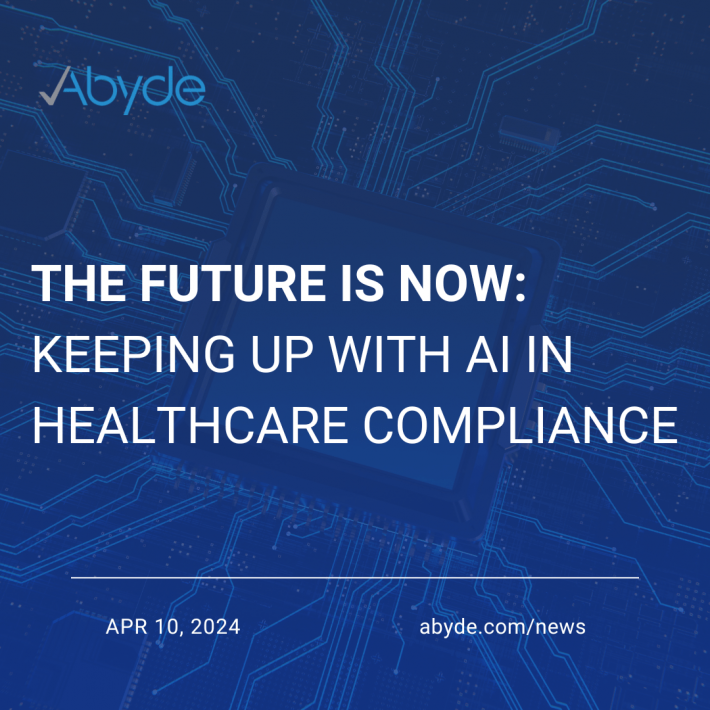
The Future is Now: Keeping Up with AI in Healthcare Compliance

April 10, 2024 Gaurav Modi Comments Off on The Future is Now: Keeping Up with AI in Healthcare Compliance

April 10, 2024 It’s hard not to marvel at the updates in technology. Maybe it’s not exactly what we expected from the Jetsons’, but it’s pretty close, especially with the recent push of Artificial Intelligence over the past two years.  Artificial Intelligence, more commonly known as AI, is the technology that simulates human behavior and capabilities.  AI has become much more accessible to the public and has transformed how we work. One of the most common AI platforms used is ChatGPT, a generative AI tool that can write anything in seconds – and definitely helps in the medical field. For example, ChatGPT can help with scheduling appointments, treatment plan assistance, patient education, and medical coding. But here’s the thing:  With all this amazing AI tech floating around, we gotta make sure it’s used in compliance with HIPAA.  We put together everything you need to know about using ChatGPT in a HIPAA-compliant way here!  While more AI tools are revolutionizing healthcare, it raises a crucial question: how do we stay HIPAA compliant?  Well, look no further! We’re blasting off into the future and giving everything you need to know when it comes to AI in healthcare.  AI Companies +  BAAs = BFFs These new healthcare AI companies would fall under Business Associates (BAs), if they have access to your patients’ Protected Health Information (PHI).  With every BA, it’s required to have a Business Associate Agreement (BAA). BAAs are documents that establish the working relationship between a Covered Entity (CE) and a Business Associate, describing each party’s responsibilities when it comes to the protection of patients’ sensitive information.  However, not all AI companies are willing to jump on the BAA bandwagon. By signing this agreement, they take on that shared responsibility when it comes to protecting PHI.  For instance, Open AI currently does not sign BAAs for ChatGPT, so sharing ePHI with them would not be HIPAA compliant.  However, some tech giants are willing to sign BAAs for their AI platforms. For instance,  Google has made strides in healthcare AI tools and has a process to enter a BAA with them for certain services. Give it a Double Take While AI can level up your practice, ensure that you keep a watchful eye on what information AI is producing. We are still in the infancy stage of AI in healthcare, and it’s bound to make mistakes.  Here’s your fun fact for the day. Did you know that when AI makes a mistake, it’s called a hallucination? Like how when we see things that aren’t there, the AI platform is ‘seeing’ patterns of information incorrectly, resulting in an inaccurate result.  So, when using AI, make sure you always give it the once over, making sure it’s on the right track.  What does the future of compliance look like?  Well, we know for sure more legislation is coming out regarding Artificial Intelligence. With the rise of new technologies in healthcare, like online tracking, the Office For Civil Rights (OCR) will release new guidance.  Artificial Intelligence is already on the radar for the government, with the Biden Administration unveiling an Executive Order on AI. Additionally, major healthcare organizations have committed to handling AI technology carefully, harnessing potential, while managing risks.  What can I do?  It’s a great, big beautiful tomorrow when it comes to the future of healthcare technology. We’re all along for the ride on the Carousel of Progress (Disney fans, anyone?).  Staying on top of the latest compliance updates is key to remaining compliant.  That’s how Abyde can help. We make compliance easy, making it the easiest part of running your practice or business. As technology continues to improve so should your compliance program. We turn the old binder in your practice or business into cloud-based software, making everything you need for compliance easily accessible.  To learn more about current compliance legislation, email us at info@abyde.com and schedule a consultation here for Covered Entities, and here for Business Associates.   

  • Facebook
  • Instagram
  • LinkedIn
  • YouTube
Abyde Logo

1.800.594.0883 | info@abyde.com

Automated HIPAA and OSHA Compliance

Our Reviews

From Our Blog
  • Don’t Get Caught Off Guard: HIPAA Audits are Back!
  • Don’t Be a Statistic: Why OSHA Compliance Matters in Healthcare
  • What Money Doesn’t Cover: The True Price of HIPAA Non-Compliance
  • HIPAA: It’s Not Just a Training – Your Guide to Continuous Compliance
Solutions
  • HIPAA for Covered Entities
  • OSHA for Healthcare
  • HIPAA for Business Associates
  • SRA for Covered Entities
  • Abyde Incident Response Program
  • Abyde Reseller Program
Resources
  • News
  • Events
  • Partners
  • HIPAA Badges
  • OSHA Badges
  • Learning Center
  • Compliance FAQs
Company
  • About Us
  • Who We Serve
  • Pricing
  • Contact Us
  • Newsletter
  • Jobs
  • COPYRIGHT © 2026 ABYDE
  • |

  • TERMS & CONDITIONS
  • |

  • PRIVACY POLICY
  • |

  • SECURITY MEASURES
  • |

  • E-SIGNATURE TERMS