Skip to content
  • About Us
    • Who We Serve
  • Solutions
    • HIPAA for Covered Entities
    • OSHA for Healthcare
    • HIPAA for Business Associates
    • SRA for Covered Entities
    • Abyde Incident Response Program
    • Abyde Reseller Program
  • Resources
  • News
  • Events
  • Partners
  • Contact Us
  • Login
    • HIPAA for Covered Entities
    • OSHA for Healthcare
    • HIPAA for Business Associates
    • SRA for Covered Entities
SIGN UP
BOOK A DEMO

Fraud, Waste, and Abuse in Healthcare

August 6, 2021

Fraud, waste, and abuse are three little words that have impacted the rising cost of healthcare in a way that’s anything but little. Now, most are probably aware that U.S. health expenditures are growing at a rapid rate, and have been for many years. And while there are many reasons that resulted in the healthcare industry closing out 2020 with a whopping $3.8 trillion tab – ‘fraud’ is a five-letter word that can account for about $60 billion of it. So with an issue this common and costly, how can patients and providers help to stop it? 

What is it? 

Now, you’ve probably heard of fraud, waste, and abuse before and can associate each of them with nothing but bad news but what exactly do they mean to healthcare specifically?  

  • Fraud is knowingly and willfully executing or attempting to execute a scheme to defraud a health care benefit program. Examples of this could be knowingly billing for services or supplies that weren’t actually provided, billing for nonexistent prescriptions, or altering claims forms or medical records to receive a higher payment. 
  • Waste is the careless overuse of health services and could be done by conducting excessive office visits, writing excessive prescriptions, or ordering excessive laboratory tests. 
  • And abuse includes actions that may either directly or indirectly result in unnecessary health care costs. This involves payment for items or services when there is not legal entitlement to that payment and the provider has not knowingly and or intentionally misrepresented facts to obtain payment.

Who can commit fraud? 

The answer to this question is pretty much anyone. This includes doctors, patients, billing services…you name it. That being said, as a healthcare provider – it’s your job to not only ensure that you aren’t partaking in any fraudulent activities but are also on the lookout for your staff, patients, and billing providers.

How do I prevent it? 

As a provider, it’s important to develop appropriate prevention policies for your organization that outline best practices for avoiding and detecting healthcare fraud, waste, and abuse. According to the HHS Office of the Inspector General, this program should “establish a culture within an organization that promotes prevention, detection, and resolution of instances of conduct that do not conform to Federal and State law, and Federal, State and private payer healthcare program requirements, as well as the organizations’ ethical and business policies,” and include some of the following components: 

  • Implementing standards and policies that are specific to your organization.
  • Providing training and education for doctors and staff.
  • Developing processes to receive and log healthcare fraud reports and complaints as well as procedures to protect anonymity consistent with the Whistleblower Protection Act.
  • Updating policies and procedures on a continual basis to meet changes in laws and regulations.

In helping to reduce and ultimately prevent fraud and abuse, it’s important for your organization to not only have the proper compliance programs in place but also take additional measures such as:

  • Validating all member ID cards prior to providing healthcare services and making copies of each patient’s insurance card and driver’s license.
  • Maintaining a treatment record for each patient and properly documenting the services provided, ordered, and prescriptions that are written.
  • Ensuring that all bills or claims are submitted accurately and in a timely manner.
  • Avoiding unnecessary drug prescription and/or medical treatment.
  • Reporting any suspicious activity to the fraud hotline or filing it online. 

With billions of dollars lost each year to health care fraud in the U.S., and the costly impact an investigation could have on your organization’s reputation and revenue – it’s important to have the processes in place to detect and prevent fraud and abuse. Ensuring that your practice is meeting all areas of healthcare compliance, including a complete HIPAA program, is essential to keeping up with government standards and best protecting your patients.

So while the rising cost of healthcare might not be totally avoidable, having the right compliance programs in place mean that the expense of a HIPAA or fraud violation can be. And with the penalties ranging from fines of hundreds of thousands of dollars and some even resulting in jail time – proactively preventing incidents before they happen and ensuring complete compliance is priceless.
RECENT POSTS

  • OSF Healthcare HIPAA Settlement
    What OSF Healthcare's Ransomware Fine Teaches Every Practice About SRAs
  • Spencer Gifts HIPAA Fine
    Spencer Gifts HIPAA Settlement: Ransomware, Risk Analysis, and What Comes Next
  • OCR Ransomware Settlements
    OCR Ransomware Settlements: 4 Massive HIPAA Fines from April 2026 & How to Avoid Them
PrevPreviousHow Are You Controlling Access to Your ePHI?
NextThe Security Risk Analysis and its Many MisconceptionsNext

Related posts

HIPAA vs SOC 2
Best Practices, Cybersecurity, HIPAA

HIPAA vs SOC 2: What’s the Difference?

May 5, 2024 Ahmedabad Dev No comments yet

Students must be equipped with the skills to navigate the digital world effectively, including using computers.

Promoting Safety in Dentistry
Best Practices, OSHA

Smile with Confidence: Promoting Safety in Dentistry

April 16, 2024 Gaurav Modi Comments Off on Smile with Confidence: Promoting Safety in Dentistry

April 16, 2024 Happy Toothsday! Okay, okay, yes, we know that was bad. Regardless, we hope you’re having a lovely beginning of the week.  Working in dentistry can be very rewarding, You know that confident feeling of rocking a fantastic smile? In dentistry, you get to create that feeling for people every day.  However, dentistry comes with challenges, like working with sharps daily and the possible exposure to bloodborne pathogens.   Here at Abyde, we’re all about prevention and safety. Today, we’re jumping right into promoting safety in dental offices. By following the right procedures, you can focus on what’s important: creating dazzling smiles!  Gear Up for Grins When working at your practice, having the proper Personal Protective Equipment (PPE) is vital. PPE encompasses all the protective gear you need to wear to ensure your safety while working with patients. This includes equipment like: While your masks and gloves might not be the most fashionable statement pieces, by rocking the correct PPE, you can minimize exposure to germs and other dental hazards, keeping you safe.  Let’s face it (pun intended!), dentistry can get a little…messy at times.  That’s where PPE comes in!  Face shields and glasses act as your splash guards, keeping your eyes protected from any flying fluids or debris. Gloves also minimize contact, keeping your hands covered when delivering exceptional patient care.  This way, you can focus on creating beautiful smiles without worrying about exposure. Syringe Savvy Using sharps is part of the dental world. That’s why we recommend the latest and safest tools. Think of it this way: those fancy safety features on your dental devices aren’t just bells and whistles – they’re game-changers! Sure, change can be a bit daunting, but these innovations are designed to make your practice safer, smoother, and ultimately, more awesome.   Some of the common safety tools include:  Bite-sized Learning When protecting your staff, training is key. With excellent training, your staff can be equipped with the knowledge they need to be safe.  This includes mastering the proper steps for sharps and bloodborne pathogens, two of the most common safety issues in a dentist’s office.  These situations can be tricky, but with the proper training, your team can conquer any challenge with ease.  How Abyde Can Help We know that paperwork and regulations can feel like a cavity that just won’t quit. That’s why we make it simple. Abyde is a software solution that makes compliance easy. With Abyde, we offer a variety of resources to make compliance a breeze, including training on everything you need for dental compliance.  To learn more about what it takes to be compliant in your dental practice, email us at info@abyde.com and schedule a consultation here.

AI in Healthcare Compliance
HIPAA

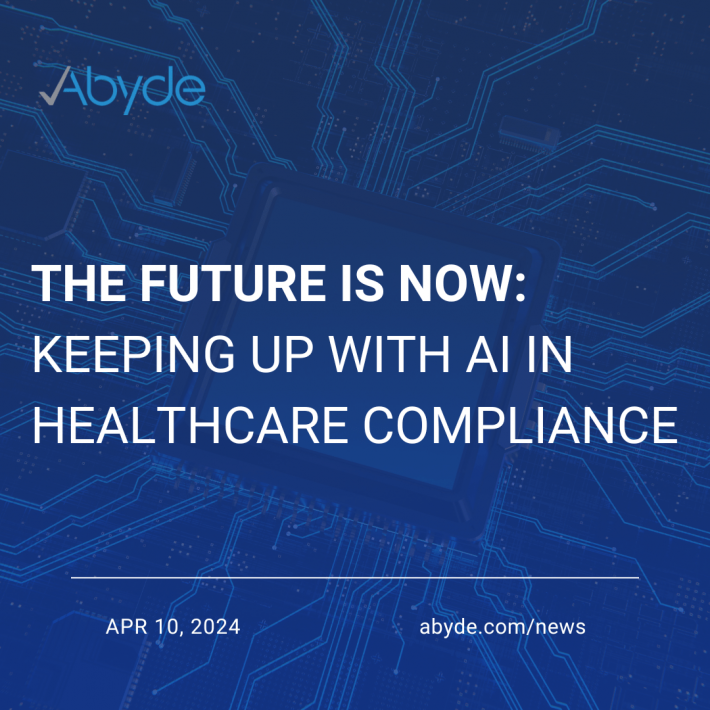
The Future is Now: Keeping Up with AI in Healthcare Compliance

April 10, 2024 Gaurav Modi Comments Off on The Future is Now: Keeping Up with AI in Healthcare Compliance

April 10, 2024 It’s hard not to marvel at the updates in technology. Maybe it’s not exactly what we expected from the Jetsons’, but it’s pretty close, especially with the recent push of Artificial Intelligence over the past two years.  Artificial Intelligence, more commonly known as AI, is the technology that simulates human behavior and capabilities.  AI has become much more accessible to the public and has transformed how we work. One of the most common AI platforms used is ChatGPT, a generative AI tool that can write anything in seconds – and definitely helps in the medical field. For example, ChatGPT can help with scheduling appointments, treatment plan assistance, patient education, and medical coding. But here’s the thing:  With all this amazing AI tech floating around, we gotta make sure it’s used in compliance with HIPAA.  We put together everything you need to know about using ChatGPT in a HIPAA-compliant way here!  While more AI tools are revolutionizing healthcare, it raises a crucial question: how do we stay HIPAA compliant?  Well, look no further! We’re blasting off into the future and giving everything you need to know when it comes to AI in healthcare.  AI Companies +  BAAs = BFFs These new healthcare AI companies would fall under Business Associates (BAs), if they have access to your patients’ Protected Health Information (PHI).  With every BA, it’s required to have a Business Associate Agreement (BAA). BAAs are documents that establish the working relationship between a Covered Entity (CE) and a Business Associate, describing each party’s responsibilities when it comes to the protection of patients’ sensitive information.  However, not all AI companies are willing to jump on the BAA bandwagon. By signing this agreement, they take on that shared responsibility when it comes to protecting PHI.  For instance, Open AI currently does not sign BAAs for ChatGPT, so sharing ePHI with them would not be HIPAA compliant.  However, some tech giants are willing to sign BAAs for their AI platforms. For instance,  Google has made strides in healthcare AI tools and has a process to enter a BAA with them for certain services. Give it a Double Take While AI can level up your practice, ensure that you keep a watchful eye on what information AI is producing. We are still in the infancy stage of AI in healthcare, and it’s bound to make mistakes.  Here’s your fun fact for the day. Did you know that when AI makes a mistake, it’s called a hallucination? Like how when we see things that aren’t there, the AI platform is ‘seeing’ patterns of information incorrectly, resulting in an inaccurate result.  So, when using AI, make sure you always give it the once over, making sure it’s on the right track.  What does the future of compliance look like?  Well, we know for sure more legislation is coming out regarding Artificial Intelligence. With the rise of new technologies in healthcare, like online tracking, the Office For Civil Rights (OCR) will release new guidance.  Artificial Intelligence is already on the radar for the government, with the Biden Administration unveiling an Executive Order on AI. Additionally, major healthcare organizations have committed to handling AI technology carefully, harnessing potential, while managing risks.  What can I do?  It’s a great, big beautiful tomorrow when it comes to the future of healthcare technology. We’re all along for the ride on the Carousel of Progress (Disney fans, anyone?).  Staying on top of the latest compliance updates is key to remaining compliant.  That’s how Abyde can help. We make compliance easy, making it the easiest part of running your practice or business. As technology continues to improve so should your compliance program. We turn the old binder in your practice or business into cloud-based software, making everything you need for compliance easily accessible.  To learn more about current compliance legislation, email us at info@abyde.com and schedule a consultation here for Covered Entities, and here for Business Associates.   

  • Facebook
  • Instagram
  • LinkedIn
  • YouTube
Abyde Logo

1.800.594.0883 | info@abyde.com

Automated HIPAA and OSHA Compliance

Our Reviews

From Our Blog
  • Don’t Get Caught Off Guard: HIPAA Audits are Back!
  • Don’t Be a Statistic: Why OSHA Compliance Matters in Healthcare
  • What Money Doesn’t Cover: The True Price of HIPAA Non-Compliance
  • HIPAA: It’s Not Just a Training – Your Guide to Continuous Compliance
Solutions
  • HIPAA for Covered Entities
  • OSHA for Healthcare
  • HIPAA for Business Associates
  • SRA for Covered Entities
  • Abyde Incident Response Program
  • Abyde Reseller Program
Resources
  • News
  • Events
  • Partners
  • HIPAA Badges
  • OSHA Badges
  • Learning Center
  • Compliance FAQs
Company
  • About Us
  • Who We Serve
  • Pricing
  • Contact Us
  • Newsletter
  • Jobs
  • COPYRIGHT © 2026 ABYDE
  • |

  • TERMS & CONDITIONS
  • |

  • PRIVACY POLICY
  • |

  • SECURITY MEASURES
  • |

  • E-SIGNATURE TERMS