Skip to content
  • About Us
    • Who We Serve
  • Solutions
    • HIPAA for Covered Entities
    • OSHA for Healthcare
    • HIPAA for Business Associates
    • SRA for Covered Entities
    • Abyde Incident Response Program
    • Abyde Reseller Program
  • Resources
  • News
  • Events
  • Partners
  • Contact Us
  • Login
    • HIPAA for Covered Entities
    • OSHA for Healthcare
    • HIPAA for Business Associates
    • SRA for Covered Entities
SIGN UP
BOOK A DEMO

Brushing Up on Whistleblower Rights – No Fillings Required!

August 11, 2023

Navigating the world of workplace safety can sometimes feel like scheduling a dental appointment – necessary but often anxiety-inducing. But just as we prefer our dental check-ups to be cavity-free, our workplace environments should be risk-free. A recent court judgment highlighted that when it comes to voicing concerns, it’s not just about flossing daily but standing up for safety!

In Peoria, Dr. Monzer K. Al-Dadah probably thought he was pulling a fast one (and we’re not talking about teeth) when he terminated a dental assistant for raising concerns about coronavirus infection risks. This wasn’t just any dental assistant, mind you, but one with more than two decades of service – perhaps old enough to remember the pre-electric toothbrush days!

When Dr. Al-Dadah learned of an anonymous safety complaint to OSHA in March 2020, he tried to ‘drill’ down to identify the whistleblower. Unsuccessful in his detective efforts, he chose to let go of the dental assistant. The assistant filed a complaint with OSHA, showing the resilience of a tooth that refuses to get extracted.

Fast forward a bit, and OSHA, acting like the dental hygienist who discovers you’ve been skipping your nightly brush, wasn’t too pleased. They determined a clear breach of whistleblower protections. This led to Dr. Al-Dadah being ordered to cough up $20,000 in back wages – that’s a lot of dental floss!

Denise Keller, the OSHA Assistant Regional Administrator in Chicago, summed it up with a reminder that workers should feel as confident voicing concerns about safety as they do showing off those pearly whites after a cleaning, “Employees must be able to exercise their legal rights regarding workplace safety freely and without fear of retaliation.”

All in all, just as we’re advised not to be lax with our oral hygiene, it’s clear we shouldn’t be lax about workplace safety either. For those curious about whistleblower protections, OSHA’s Whistleblower Protection Programs webpage is as enlightening as that little mirror your dentist uses.

Here at Abyde, while we can’t help with plaque, we’re all in for promoting workplace safety and transparency with a dose of humor! Remember, when it comes to safety, always brush and floss (or voice concerns) daily! 
RECENT POSTS

  • Spencer Gifts HIPAA Fine
    Spencer Gifts HIPAA Settlement: Ransomware, Risk Analysis, and What Comes Next
  • OCR Ransomware Settlements
    OCR Ransomware Settlements: 4 Massive HIPAA Fines from April 2026 & How to Avoid Them
  • OSHA 2026 GHS Deadlines
    2026 OSHA HazCom Deadlines: How the GHS Update Impacts Your Practice
PrevPreviousOCR’s COVID-19 Telehealth Enforcement Discretion Transition Period Ends
NextUnleash Your Inner Compliance Hero: 5 Must-Haves for Your Healthcare PracticeNext

Related posts

OSHA 2026 GHS Deadlines
Abyde News, Legislation, OSHA

2026 OSHA HazCom Deadlines: How the GHS Update Impacts Your Practice

March 23, 2026 Penelope Schweitzer No comments yet

March 23, 2026   Quick Guide: 2026–2028 OSHA HazCom Deadlines (as of March 2026) May 19, 2026: Deadline for manufacturers to update labels for pure substances. Nov 20, 2026: Deadline for practices to update written HazCom programs and staff training for substances. May 19, 2028: Final deadline for practices to be fully compliant for all mixtures (disinfectants, resins, etc.). If you came here after hearing that a major OSHA deadline is coming up in May 2026, then you can exhale. You aren’t late (yet)… although if you are reading this closer to November, you can panic [a little]. The changes are actually not terribly complex for your practice, as we will explain in this blog, so you can be prepared.   What is GHS, and why does it exist? The Globally Harmonized System can be thought of as a standardized or universal language that is aligned with GHS Revision 7. Since chemical manufacturing occurs all over the globe, something made in one country might use different warning symbols and formats than something made here in the U.S., which can be confusing, if not problematic, for those who use them.  OSHA is updating its standards so that every chemical label and Safety Data Sheet (SDS) uses the same icons (called pictograms) and formatting worldwide, helping your team to easily identify what is what, no matter where the product came from.   Why are there so many deadlines? There are really two different audiences for the deadlines: manufacturers and consumers of the chemicals. There are also two waves of chemical classes with different priorities: Pure Substances and Mixtures. Wave 1 – Pure Substances (Deadline: Nov 20, 2026) This first wave covers “pure” chemicals, or products that have only one main ingredient. For many practices, this list tends to be short including (but not limited to) medical gas – like 100% Oxygen or Nitrous Oxide, bulk alcohol – like 99% Isopropyl Alcohol, etc. Wave 2 – Mixtures (Deadline: May 19, 2028) Most products are likely “mixtures” of several chemicals. Because these are more complex to re-label, OSHA has given everyone until 2028 to reach full compliance. This includes most surface disinfectants, cleaners, clinical materials, etc. What if we mix things ourselves? Most mixtures you do in-house are probably to dilute other “mixtures” (ie: secondary container labeling). But say, for instance, you still mix your own amalgam – you have a unique situation where you’re dealing with two different deadlines. Your mercury needs updated labels by Nov 2026, but the alloy you’re mixing with would fit the mixture deadline, as would the final product.   When will we see changes? You might have heard about a May 19, 2026, deadline. That is the deadline for the manufacturers to have their pure substance labels ready. Here is when you can expect to see the changes in your orders: May 2026 (Manufacturer Deadline) New labels for pure substances. Nov 2027 (Manufacturer Deadline) New labels for all mixtures.   Should I be doing anything now? Just be aware of the changes and try to notice them. You may already see some manufacturers have these changes live; others may happen by the deadline. The key is effective Safety Data Sheet (SDS) management. When a new version of an SDS arrives, simply swap it out in your library (whether that’s a physical binder or stored digitally). Replacing them as they come in is much easier than doing a mass update in November. If you haven’t received new sheets for your pure substances by this summer, you can reach out to your vendor to request the GHS-aligned version. The other change you’ll notice is products adding the GHS hazard pictograms where previously they had none or few. When you spot these, show them to your team during a morning meeting and explain what each icon means. It’s a simple way to keep staff informed and safe. Beyond that, start thinking about updates to your OSHA Hazard Communication training.   Need Help? We get it, you didn’t get into healthcare to become an OSHA expert… But we did. If you want to stay up to date on the deadlines and get the easy button covered for OSHA compliance, our platform and our compliance experts are here to help you do exactly that. If you’d like to learn more about Abyde and how we can help, check out our OSHA for Healthcare platform.

OSHA Investigation in Healthcare
Abyde News, Best Practices, OSHA

So… OSHA Just Walked In: What Happens Next

November 13, 2025 Penelope Schweitzer No comments yet

November 13, 2025   OSHA doesn’t always call ahead. No heads-up. No appointment. Just, “We’re here. Let’s review your documentation and take a look around.” In fact, half the time OSHA investigates a practice, it’s unannounced.  Aside from a random investigation, if anyone in your practice issues a complaint about the work environment or if someone is seriously injured, it’s common for OSHA to conduct an investigation.  Take a deep breath! With proactive compliance and an understanding of the investigation process, you can pass with flying colors, keeping your staff safe.    What’s an OSHA Investigation?  OSHA inspections are routine visits to make sure workplaces are following safety rules.  OSHA will target high-risk workplaces, like construction, manufacturing, and, you guessed it, healthcare.  When work-related illnesses and injuries in the healthcare industry surpass other fields, it’s no wonder that healthcare is a priority for OSHA.  The OSHA official will begin with an opening conference to explain their purpose and the scope of their review. After that, they’ll do a walk-through of your practice and look over your documentation to confirm your safety measures are in place. This can include checking for basics like eye wash stations and accessible fire extinguishers. Your OSHA materials, including risk assessments, SDS library, policies, procedures, and other relevant documents, should be organized and easily accessible to staff. The OSHA investigator can and will also interview staff. Like a pop quiz, your staff must be trained and ready to answer any questions at any time about safety precautions. While being quizzed on OSHA training might not be as fun as being on Jeopardy!, being aware and confident of your practice’s proactive compliance will save your practice from ‘doubling down’ on a massive fine.  After a review, a closing conference will be held to review results and next steps.    So, what’s after an OSHA Investigation?  If everything goes well, hopefully it’s nothing!  However, OSHA can and will fine practices found with violations. When the minimum cost of a fine is over a thousand dollars, these violations can quickly add up. In fact, depending on the situation, OSHA fines can cost over $160,000 a violation! Additionally, it can become public record that your practice failed an OSHA audit. OSHA will likely place you on a corrective action plan, ensuring your practice takes the necessary precautions to keep your staff safe.    How can I get OSHA Compliant Today? OSHA penalties don’t just sting your budget — they can hurt your reputation, too. But the real reason to stay on top of OSHA isn’t the fine, it’s your people. Protecting your team from preventable injuries and exposures should always come first; avoiding penalties is just the nice side effect. While compliance may feel complicated, it doesn’t have to be that way with the right solution. Smart software can analyze your practice’s compliance standings, offer recommendations, dynamically generate documentation, provide thorough training, and more to ensure your staff is safe every day in your office.  Schedule a meeting with a compliance expert to learn more about OSHA compliance in your practice. 

HIPAA Dental Photography
Abyde News, Best Practices, HIPAA

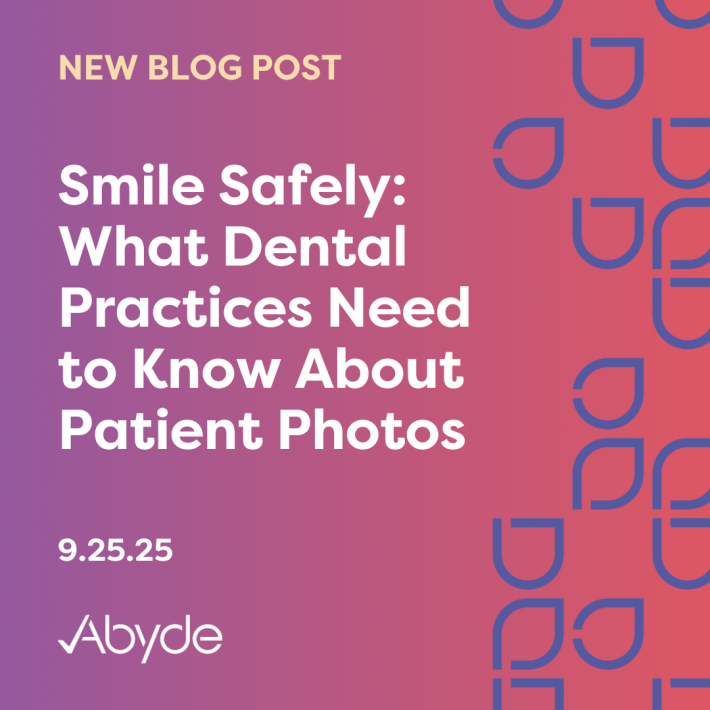
Smile Safely: What Dental Practices Need to Know About Patient Photos

September 25, 2025 Penelope Schweitzer No comments yet

September 25, 2025   Smile! Members of your dental practice look at countless images of your patients’ pearly whites daily. However, it can be a major HIPAA violation if your practice doesn’t handle these images carefully. While X-rays of a patient seem anonymous, X-rays and patient medical imaging are considered Protected Health Information (PHI). PHI is health data that can easily be linked to an individual patient. In fact, X-rays also usually include further information, including a patient’s full name and birthday, to ensure they are appropriately assigned and shared with the right patient. The same goes for images of patients’ teeth taken with a traditional camera. HIPAA is about keeping patient information safe, protecting healthcare data, and holding everyone accountable.  So, your practice’s job is to keep patient images from curious eyes peeking where they shouldn’t.   No Peeking! When handling X-rays and other forms of dental photography, ensure that role-based permissions are correctly assigned. In other words, ensure that whoever has access to these images truly needs access. For example, your receptionist most likely doesn’t need access to a patient’s X-rays, but your head dentist would. Your practice must assign these roles to keep patient data safe and terminate any access once an employee leaves or roles change. A recent HIPAA fine highlights the importance of this, with an $800,000 fine after one patient became aware of improper staff access. Your practice should also routinely monitor access to PHI, ensuring that a) the viewer can view specific patient images and b) it makes sense when and how long they review PHI. For example, your practice’s billing staff doesn’t need to look at a patient’s health records at 3 a.m. Noticing odd access to PHI can let your practice catch issues quickly, like hackers.   Smile for the Camera (and get an Autograph!) While it’s vital to keep patients’ medical images, such as X-rays and traditional photos, under lock and key, with the right documentation, you can share these images publicly. Let’s say your practice wants to share a patient’s orthodontic journey with braces on social media with a before-and-after post. Before posting anything, make sure your patient signs a media consent form. These forms should be thorough and documented by your practice. A patient must be able to revoke consent easily at any time. While you have this consent, keeping any images as anonymous as possible is still best practice. You shouldn’t be tagging your patients in social media posts!   Smile with Compliance Confidence As they say, a picture is worth a thousand words, and in healthcare, those words are PHI that must stay protected. Dental images play a key role in diagnosing and treating patients, which is why your practice needs to keep this form of PHI secure. With the right compliance solution, your practice can simplify HIPAA by managing everything in one centralized hub. Important documents, like media consent forms, are always easy to access. Connect with a HIPAA expert today to learn how to streamline compliance.

  • Facebook
  • Instagram
  • LinkedIn
  • YouTube
Abyde Logo

1.800.594.0883 | info@abyde.com

Automated HIPAA and OSHA Compliance

Our Reviews

From Our Blog
  • Don’t Get Caught Off Guard: HIPAA Audits are Back!
  • Don’t Be a Statistic: Why OSHA Compliance Matters in Healthcare
  • What Money Doesn’t Cover: The True Price of HIPAA Non-Compliance
  • HIPAA: It’s Not Just a Training – Your Guide to Continuous Compliance
Solutions
  • HIPAA for Covered Entities
  • OSHA for Healthcare
  • HIPAA for Business Associates
  • SRA for Covered Entities
  • Abyde Incident Response Program
  • Abyde Reseller Program
Resources
  • News
  • Events
  • Partners
  • HIPAA Badges
  • OSHA Badges
  • Learning Center
  • Compliance FAQs
Company
  • About Us
  • Who We Serve
  • Pricing
  • Contact Us
  • Newsletter
  • Jobs
  • COPYRIGHT © 2026 ABYDE
  • |

  • TERMS & CONDITIONS
  • |

  • PRIVACY POLICY
  • |

  • SECURITY MEASURES
  • |

  • E-SIGNATURE TERMS