Skip to content
  • About Us
    • Who We Serve
  • Solutions
    • HIPAA for Covered Entities
    • OSHA for Healthcare
    • HIPAA for Business Associates
    • SRA for Covered Entities
    • Abyde Incident Response Program
    • Abyde Reseller Program
  • Resources
  • News
  • Events
  • Partners
  • Contact Us
  • Login
    • HIPAA for Covered Entities
    • OSHA for Healthcare
    • HIPAA for Business Associates
    • SRA for Covered Entities
SIGN UP
BOOK A DEMO

OSHA 2025: What Healthcare Professionals Need to Know

February 3, 2025

We’ve already seen that 2025 will be a year of major healthcare compliance changes, with the OCR releasing the long-awaited updates to the Security Rule proposal. 

Similar to how HIPAA laws are being updated, OSHA will likely update key legislation for healthcare workers. 

Healthcare workers experience the highest rates of workplace injuries, with an average of 3.6 injuries for every 100 employees.  

Healthcare environments can present many hazards, so it is essential that your staff knows how to prevent and mitigate dangerous situations. 

While some OSHA initiatives have not been finalized, OSHA has already started the year with legislation that impacts healthcare workers. 


Increased Penalty Costs

As seen in previous years, OSHA has once again increased its fine cost. OSHA has increased the penalty for serious and other-than-serious violations from $16,131 to $16,550 per violation due to inflation. The maximum penalty for repeated and willful violations also has been increased from $161,323 to $165,514 per violation. 

This highlights that OSHA is dedicated to setting an example with monetary punishment. It’s safe to say that this adjustment will continue to be an annual increase. 


Consolidating COVID-19 Regulations

It’s an understatement to say that COVID-19 devastated and transformed healthcare. 

Nearly five years since it was classified as a pandemic, proposed healthcare OSHA COVID-19 regulations were officially scrapped as of early January.

Over the past years, COVID-19 regulations have been altered. Emergency Temporary Standards required distinctive protocols to follow, which expired. A proposed rule for COVID-19 mitigation in healthcare settings was waiting to be passed for years. 

Now, specific OSHA COVID-19 legislation in healthcare will be rolled into a broader infectious disease rule, which is expected to be finalized in 2025. This comprehensive rule is expected to require COVID-19 recordkeeping log, but not much else focused on specifically COVID-19. The anticipated comprehensive rule will likely mandate a COVID-19 recordkeeping log. 


Federal Workplace Violence Legislation 

Healthcare workers are five times more likely to be attacked at work than workers in any other industry. 

We’ve seen state-level legislation announced requiring specific logs, training, heightened penalties, and more to mitigate workplace violence in healthcare, but federal legislation is still being drafted. Currently, workplace violence falls under OSHA’s General Duty Clause, requiring organizations to maintain “a place of employment which are free from recognized hazards.” 

This federal legislation is expected to be announced in 2025. It will likely mirror what state legislation requires, so please review your state’s legislation regarding workplace violence prevention in your practice. 


What’s Next? 

As new legislation is announced, it’s vital for your practice to maintain an organized OSHA program. New laws, especially focused on workplace violence prevention, will require additional training, logs, and more.

Turning to smart software can allow for your practice to simplify and streamline compliance. Cloud-based software automatically updates with the latest legislation, providing your practice with a clear path to compliance. 

To learn more about how your practice can achieve OSHA compliance, meet with our experts today. 
 

RECENT POSTS

  • OSF Healthcare HIPAA Settlement
    What OSF Healthcare's Ransomware Fine Teaches Every Practice About SRAs
  • Spencer Gifts HIPAA Fine
    Spencer Gifts HIPAA Settlement: Ransomware, Risk Analysis, and What Comes Next
  • OCR Ransomware Settlements
    OCR Ransomware Settlements: 4 Massive HIPAA Fines from April 2026 & How to Avoid Them
PrevPreviousHIPAA Help: Your Top Compliance Questions Answered
NextHIPAA in Eye Care: Are You Doing Enough?Next

Related posts

OSHA 2026 GHS Deadlines
Abyde News, Legislation, OSHA

2026 OSHA HazCom Deadlines: How the GHS Update Impacts Your Practice

March 23, 2026 Penelope Schweitzer No comments yet

March 23, 2026   Quick Guide: 2026–2028 OSHA HazCom Deadlines (as of March 2026) May 19, 2026: Deadline for manufacturers to update labels for pure substances. Nov 20, 2026: Deadline for practices to update written HazCom programs and staff training for substances. May 19, 2028: Final deadline for practices to be fully compliant for all mixtures (disinfectants, resins, etc.). If you came here after hearing that a major OSHA deadline is coming up in May 2026, then you can exhale. You aren’t late (yet)… although if you are reading this closer to November, you can panic [a little]. The changes are actually not terribly complex for your practice, as we will explain in this blog, so you can be prepared.   What is GHS, and why does it exist? The Globally Harmonized System can be thought of as a standardized or universal language that is aligned with GHS Revision 7. Since chemical manufacturing occurs all over the globe, something made in one country might use different warning symbols and formats than something made here in the U.S., which can be confusing, if not problematic, for those who use them.  OSHA is updating its standards so that every chemical label and Safety Data Sheet (SDS) uses the same icons (called pictograms) and formatting worldwide, helping your team to easily identify what is what, no matter where the product came from.   Why are there so many deadlines? There are really two different audiences for the deadlines: manufacturers and consumers of the chemicals. There are also two waves of chemical classes with different priorities: Pure Substances and Mixtures. Wave 1 – Pure Substances (Deadline: Nov 20, 2026) This first wave covers “pure” chemicals, or products that have only one main ingredient. For many practices, this list tends to be short including (but not limited to) medical gas – like 100% Oxygen or Nitrous Oxide, bulk alcohol – like 99% Isopropyl Alcohol, etc. Wave 2 – Mixtures (Deadline: May 19, 2028) Most products are likely “mixtures” of several chemicals. Because these are more complex to re-label, OSHA has given everyone until 2028 to reach full compliance. This includes most surface disinfectants, cleaners, clinical materials, etc. What if we mix things ourselves? Most mixtures you do in-house are probably to dilute other “mixtures” (ie: secondary container labeling). But say, for instance, you still mix your own amalgam – you have a unique situation where you’re dealing with two different deadlines. Your mercury needs updated labels by Nov 2026, but the alloy you’re mixing with would fit the mixture deadline, as would the final product.   When will we see changes? You might have heard about a May 19, 2026, deadline. That is the deadline for the manufacturers to have their pure substance labels ready. Here is when you can expect to see the changes in your orders: May 2026 (Manufacturer Deadline) New labels for pure substances. Nov 2027 (Manufacturer Deadline) New labels for all mixtures.   Should I be doing anything now? Just be aware of the changes and try to notice them. You may already see some manufacturers have these changes live; others may happen by the deadline. The key is effective Safety Data Sheet (SDS) management. When a new version of an SDS arrives, simply swap it out in your library (whether that’s a physical binder or stored digitally). Replacing them as they come in is much easier than doing a mass update in November. If you haven’t received new sheets for your pure substances by this summer, you can reach out to your vendor to request the GHS-aligned version. The other change you’ll notice is products adding the GHS hazard pictograms where previously they had none or few. When you spot these, show them to your team during a morning meeting and explain what each icon means. It’s a simple way to keep staff informed and safe. Beyond that, start thinking about updates to your OSHA Hazard Communication training.   Need Help? We get it, you didn’t get into healthcare to become an OSHA expert… But we did. If you want to stay up to date on the deadlines and get the easy button covered for OSHA compliance, our platform and our compliance experts are here to help you do exactly that. If you’d like to learn more about Abyde and how we can help, check out our OSHA for Healthcare platform.

Notice of Privacy Practices Update
Abyde News, HIPAA, Legislation

2026 HIPAA Deadline: How to Update Your Notice of Privacy Practices (NPP) for SUD Records (42 CFR Part 2)

February 16, 2026 Penelope Schweitzer No comments yet

February 16, 2026 The latest HIPAA change is the latest updates to the Notice of Privacy Practices (NPP).        As of February 16, 2026, the newest version of the NPP must include further information about how Substance Use Disorder (SUD) Protected Health Information (PHI) is handled and secured. While this was initially ruled under the Biden administration in 2024, the updated content has seen significant changes, including the removal of proposed legislation that would treat reproductive healthcare PHI differently. However, while some states still have additional requirements for handling reproductive care PHI, those requirements were struck down at the federal level by a court ruling in 2025. Now that the deadline is here, it’s essential to understand what these changes actually mean for your practice. What’s Actually Changing in the Document? The Final Rule requires practices to update this document for patients (posted on the website and provided in-person) by February 16, 2026. Your practice must also review whether your state has additional legislation regarding reproductive healthcare PHI. Expanded Scope for SUD Information: SUD records must now be included in the NPP for all Covered Entities, regardless of whether the practice focuses specifically on SUD treatment. Standard Disclosure Language: The notice must explicitly state how the practice discloses SUD records for Treatment, Payment, and Healthcare Operations (TPO). Legal Proceeding Protections: The NPP must state that SUD records cannot be disclosed in legal proceedings without specific written patient consent or a formal court order. Single consent for TPO: The rule does allow patients to sign one consent for all future uses/disclosures of TPO. Previously, SUD records were discussed in a separate document for patients to review. Fundraising Opt-Outs: If your practice uses SUD records for fundraising communications, the NPP must clearly provide patients with the opportunity to opt out. For example, if a rehabilitation center is seeking to raise money for a new facility, it cannot reach out to former patients who have clearly opted out. Redisclosure Warning: The notice must highlight that once PHI (including SUD records) is shared with an outside party, it may be subject to redisclosure by the recipient. In other words, once it’s shared, it’s tough to control how it is shared again by third parties. Universal Accessibility: To remain compliant, practices must ensure the NPP is accessible to all patients, which includes providing translated copies. State-Specific Requirements: Depending on your state, additional protections for reproductive health PHI may still be in place. Where do I start? First, ensure your Notice of Privacy Practices (NPP) is already specific to your practice. Your final notice must be specific, include your office address, and provide clear contact information for your Compliance or Privacy Officer. To remain compliant, this notice must also be prominently displayed on your website so patients can easily access and understand their rights. Your NPP should now include a section that addresses these SUD records directly. The federal government provides model language similar to this: When applicable, we may use or disclose 42 CFR Part 2 substance use disorder records for treatment, payment, and health care operations as permitted by law. Part 2 records will not be used or disclosed in legal or administrative proceedings against you without your specific written consent or a court order. Your NPP should now include a section that mentions fundraising as well. The federal government provides model language similar to this: If we were to use or disclose substance use disorder records protected by 42 CFR Part 2 in connection with fundraising, you have the right to opt out of receiving fundraising communications in advance, before any such communications are sent. Simplify Compliance Updating your NPP can feel like just another complicated task on an already full plate. For practices where you’re wearing many hats, finding the resources for a legal deep-dive is tough. The simplest way to handle the February 16, 2026, deadline is to lean on experts. Abyde has already done the heavy lifting, automating the necessary HIPAA and SUD record updates so you can focus on what you do best: take care of patients. Reach out to our team of experts to learn more about HIPAA updates affecting your practice. Disclaimer: This post is for informational purposes only and does not constitute legal advice. Health care privacy laws are subject to frequent change and vary by state. Consult with a qualified health care attorney or compliance officer to ensure your Notice of Privacy Practices meets all current federal and state requirements.

OSHA Investigation in Healthcare
Abyde News, Best Practices, OSHA

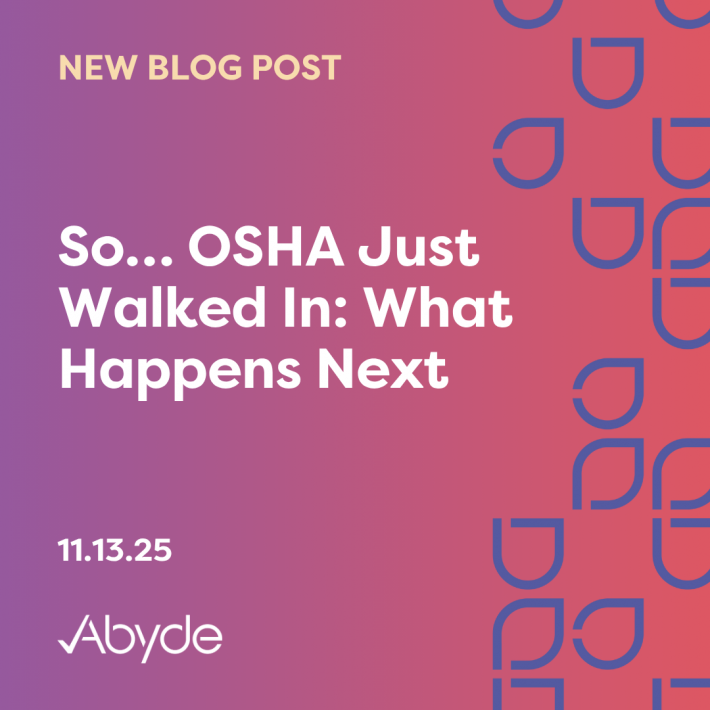
So… OSHA Just Walked In: What Happens Next

November 13, 2025 Penelope Schweitzer No comments yet

November 13, 2025   OSHA doesn’t always call ahead. No heads-up. No appointment. Just, “We’re here. Let’s review your documentation and take a look around.” In fact, half the time OSHA investigates a practice, it’s unannounced.  Aside from a random investigation, if anyone in your practice issues a complaint about the work environment or if someone is seriously injured, it’s common for OSHA to conduct an investigation.  Take a deep breath! With proactive compliance and an understanding of the investigation process, you can pass with flying colors, keeping your staff safe.    What’s an OSHA Investigation?  OSHA inspections are routine visits to make sure workplaces are following safety rules.  OSHA will target high-risk workplaces, like construction, manufacturing, and, you guessed it, healthcare.  When work-related illnesses and injuries in the healthcare industry surpass other fields, it’s no wonder that healthcare is a priority for OSHA.  The OSHA official will begin with an opening conference to explain their purpose and the scope of their review. After that, they’ll do a walk-through of your practice and look over your documentation to confirm your safety measures are in place. This can include checking for basics like eye wash stations and accessible fire extinguishers. Your OSHA materials, including risk assessments, SDS library, policies, procedures, and other relevant documents, should be organized and easily accessible to staff. The OSHA investigator can and will also interview staff. Like a pop quiz, your staff must be trained and ready to answer any questions at any time about safety precautions. While being quizzed on OSHA training might not be as fun as being on Jeopardy!, being aware and confident of your practice’s proactive compliance will save your practice from ‘doubling down’ on a massive fine.  After a review, a closing conference will be held to review results and next steps.    So, what’s after an OSHA Investigation?  If everything goes well, hopefully it’s nothing!  However, OSHA can and will fine practices found with violations. When the minimum cost of a fine is over a thousand dollars, these violations can quickly add up. In fact, depending on the situation, OSHA fines can cost over $160,000 a violation! Additionally, it can become public record that your practice failed an OSHA audit. OSHA will likely place you on a corrective action plan, ensuring your practice takes the necessary precautions to keep your staff safe.    How can I get OSHA Compliant Today? OSHA penalties don’t just sting your budget — they can hurt your reputation, too. But the real reason to stay on top of OSHA isn’t the fine, it’s your people. Protecting your team from preventable injuries and exposures should always come first; avoiding penalties is just the nice side effect. While compliance may feel complicated, it doesn’t have to be that way with the right solution. Smart software can analyze your practice’s compliance standings, offer recommendations, dynamically generate documentation, provide thorough training, and more to ensure your staff is safe every day in your office.  Schedule a meeting with a compliance expert to learn more about OSHA compliance in your practice. 

  • Facebook
  • Instagram
  • LinkedIn
  • YouTube
Abyde Logo

1.800.594.0883 | info@abyde.com

Automated HIPAA and OSHA Compliance

Our Reviews

From Our Blog
  • Don’t Get Caught Off Guard: HIPAA Audits are Back!
  • Don’t Be a Statistic: Why OSHA Compliance Matters in Healthcare
  • What Money Doesn’t Cover: The True Price of HIPAA Non-Compliance
  • HIPAA: It’s Not Just a Training – Your Guide to Continuous Compliance
Solutions
  • HIPAA for Covered Entities
  • OSHA for Healthcare
  • HIPAA for Business Associates
  • SRA for Covered Entities
  • Abyde Incident Response Program
  • Abyde Reseller Program
Resources
  • News
  • Events
  • Partners
  • HIPAA Badges
  • OSHA Badges
  • Learning Center
  • Compliance FAQs
Company
  • About Us
  • Who We Serve
  • Pricing
  • Contact Us
  • Newsletter
  • Jobs
  • COPYRIGHT © 2026 ABYDE
  • |

  • TERMS & CONDITIONS
  • |

  • PRIVACY POLICY
  • |

  • SECURITY MEASURES
  • |

  • E-SIGNATURE TERMS